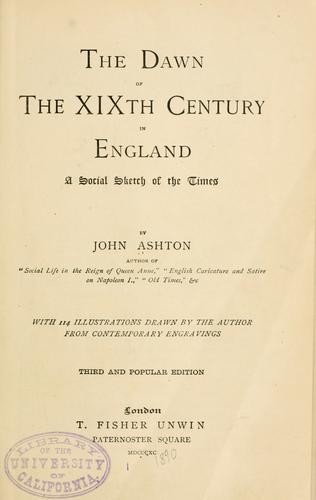
The Dawn of the XIXth Century in England: A social sketch of the timesAshton, John
History
The Dawn of the XIXth Century in England: A social sketch of the times
Ashton, John
England -- Social life and customs -- 19th century
Then, too, for breakfast, would be heard, either from male, or female,
lips, the cry of “Water cresses!” which were sold in small bunches
a penny each, or three for twopence. In those days, they were to be
found growing wild in the ditches near London, and many a weary tramp
of seven or eight miles, before breakfast, of a morning, did the
sellers have, in order to get them fresh. There was generally a supply
at Covent Garden Market—grown for sale; but these were considered
inferior in flavour to the wild ones.
[Illustration: “BUY A TRAP! A RAT TRAP! BUY MY TRAP!”]
From breakfast time, the cries of the miscellaneous dealers in small
wares became general, and hardly any can claim pre-eminence, unless
it be on a Good Friday—when the old pagan crossed cakes were vended,
and evidently as much relished by the young folks as now. “Baking, or
boiling apples” were sold by women, a charcoal stove accompanying their
barrow, so that their customers might have them hot, and luscious.
Then, too, might be seen a man with band-boxes, carried on either end
of a pole, which rested on his shoulder. From 6d. to 3s. was their
price; whilst boxes of slight deal, with a lock and key, might be
purchased from 3s. 6d. to 6s. 6d. These boxes were of home manufacture,
and gave employment to many industrious families.
Brickdust was carried about on donkey back, in small sacks, and
retailed at the price of one penny per quart. A contemporary remarks,
“As brickdust is scarcely used in London for any other purpose than
that of knife cleaning, the criers are not numerous; but they are
remarkable for their fondness, and their training, of bull dogs.
This predilection they have in common with the lamplighters of the
Metropolis.”
The accompanying sketch of a Rat-trap Dealer is graphic and good;
and it shows one glimpse of the past, in the old cobbler (?) at his
_hutch_, or low open door. This, or a cellar, always went as an
accompaniment to this branch of the shoe-making trade.
To future antiquarians, it may be useful to know that, at the
commencement of this century, our domestic animals had their “purveyors
of food;” that cat’s, and dog’s meat, consisting of horse flesh,
bullock’s livers, and tripe cuttings, were distributed by means of men,
or preferably, women, all over London. The horse flesh, and bullock’s
liver, was sold by weight at 2d. per lb.; the tripe, in bundles, at 1d.
each.
“Baskets” were hawked about—not as we know them (rarer and rarer, year
by year) in the gipsy caravans, but slung around the sellers—of good
handy size, and durable make. One article of domestic economy has all
but died out—the Bellows—and _old_ specimens are almost worth their
weight in silver; but the cry of “Bellows to mend!” was then heard
commonly. The mender carried his tools in a bag on his back, and, like
the chair-mender, plied his calling in front of his patron’s house, or
at any convenient street corner.
Public-domain text, read in full here on John Shaqi.
Reviews
Reviews
No reviews yet
Be the first to share your thoughts on this work.
Elsewhere in the archive
Join the Discussion
Join the discussion
Sign in to leave a comment or review.
Sign InorCreate an account