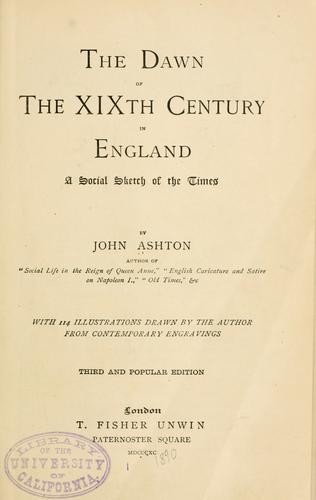
The Dawn of the XIXth Century in England: A social sketch of the timesAshton, John
History
The Dawn of the XIXth Century in England: A social sketch of the times
Ashton, John
England -- Social life and customs -- 19th century
Among the street cries, was that of “Mackerel”; and the sellers thereof
might even expose them for sale, and cry them, on Sundays—a proud
privilege which no other fish possessed. There never was a glut of them
in the market, because they could only be brought to Billingsgate by
smacks, so that they were never sold at the very cheap rates they now
are, but were, as we should think, extremely dear. At first coming in
they were sold for 1s. 6d. each, and they gradually dropped to 10d.,
8d., 6d. each, or, if there was a great haul, three might be sold for a
shilling.
[Illustration: “BUY MY GOOSE! MY FAT GOOSE!”]
might probably bring to remembrance the quotation “_Caveat emptor_,”
but these two purchasers seem quite able to take care of themselves.
It was but a month, or six weeks since, that I saw a sight I had not
seen for some years—a man selling Rabbits slung on a pole, which he
carried on his shoulder; yet this used to be the usual method of
exposing them for sale, and these small dealers were called _higglers_.
The price of Rabbits, thus sold, at the time of which I write, were
“from ninepence to eighteenpence each, which is cheaper than they can
be bought in the poulterers’ shops.”
[Illustration: “ALL A GROWING, A GROWING! HERE’S FLOWERS FOR YOUR
GARDENS!”]
shows the universal yearning of the dwellers in town, to make as good
a _rus in urbe_ of their surroundings, as possible. The atmosphere of
London was then, undoubtedly purer than now, and flowers might then be
grown in the open air, where, now, it would be an impossibility.
As an “Old Clothes” man the Jew was then paramount, the Irishman not
having, as yet, entered into competition with him. _Rosemary Lane_
(only sweet smelling in its name) was a thoroughfare now called _Royal
Mint Street_ leading from Tower Hill; and here was held a Mart, not
only in shops, but all over the pavement and road, of old clothes,
boots, &c., and it fully merited its name of _Rag Fair_. A market was
built for the buyers and sellers, in which to transact their business;
but old habits proved too strong, they would _not_ use it, and “nothing
less than military force constantly exercised would prevail over the
obstinacy of habit.” The “high” market was from twelve to three.
It was a curious custom then, of course not in good houses, but in
those of poor men, such as might be on the outskirts, and in the
suburbs of the Metropolis, to strew the floor, say of the kitchen, and
sometimes of the parlour, with silver sand. This kept the soles of
dirty boots from actual contact with the newly scrubbed boards—and
saved the housewife much exercise of temper. Sand, too, was plentifully
used in scouring kitchen utensils, and it was sold, the red sand, at
2½d., and the white at 1¼d., per peck.
Public-domain text, read in full here on John Shaqi.
Reviews
Reviews
No reviews yet
Be the first to share your thoughts on this work.
Elsewhere in the archive
Join the Discussion
Join the discussion
Sign in to leave a comment or review.
Sign InorCreate an account