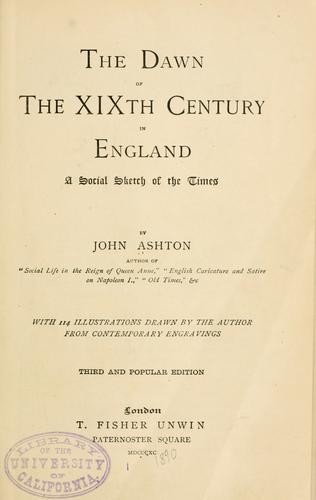
The Dawn of the XIXth Century in England: A social sketch of the timesAshton, John
History
The Dawn of the XIXth Century in England: A social sketch of the times
Ashton, John
England -- Social life and customs -- 19th century
“Chairs to mend!” might be met with anywhere. Nursery and common
chairs, if not having seats of wood, were of rushes, cane being a
later introduction. These rushes were, and are now, cut in our rivers,
preferably in the early autumn, before they begin to rot, and sold by
a peculiar measure—a _bolt_—which is as much as a man can clasp of
rushes, when dried, within his arms. The repairs were executed before
the house, and the charge for reseating a chair was very moderate—from
1s. 6d. to 2s. 6d.
“Door mats” were hawked about, as they are sometimes now, but Prisons
and Industrial Schools had not then interfered in this trade, so that
a poor man had a chance of getting rid of his handiwork, and the price
for rush, and rope, mats, varied from 6d. to 4s. each.
If we can believe a contemporary account, the Dustmen of those days
were the very pink of propriety. “Dust carts ply the streets through
the morning in every part of the metropolis; two men go with each
cart, ringing a large bell, and calling DUST O! These men, daily, if
necessary, empty the dust bins of all the refuse that is thrown into
them. They receive no gratuity from the inhabitants of the houses, the
owner of the cart pays them, like other labourers, weekly wages; and
the dust is carried to yards in the outskirts of the town, where a
number of women and girls are employed in sifting it, and separating
the cinders and bones from the ashes, and other refuse.” I much fear
that this picture is as _couleur de rose_ as the engraving which
accompanies it, wherein the model dustman, with very clean face, is
attired in a yellow jacket, green waistcoat, crimson knee-breeches,
blue ribbed stockings, and brown gaiters.
The sale of “Turnery” was also a street occupation, and brooms,
brushes, sieves, bowls, clothes horses and lines were thus vended.
Some, the Aristos of their trade, had a cart; but the perambulating
sellers could get a good living, as their wares yielded a good profit.
The Knife-grinder, immortalized by Canning, plied his trade in the
sight of the people, and his charges for grinding, and setting,
scissors, were a penny or twopence each; penknives, a penny a blade;
table knives, 1s. 6d. or 2s. per dozen, according to the polish
supplied.
“Lavender” was a cry redolent of the country, yet grown near London, at
Mitcham. This was generally used in linen-presses, to counteract the
abominably rank smell of the soap of those days. It was a favourite
scent; as Isaac Walton says, “I’ll now lead you to an honest ale
house, where we shall find a cleanly room, lavender in the windows, and
twenty ballads stuck against the wall.”
Public-domain text, read in full here on John Shaqi.
Reviews
Reviews
No reviews yet
Be the first to share your thoughts on this work.
Elsewhere in the archive
Join the Discussion
Join the discussion
Sign in to leave a comment or review.
Sign InorCreate an account