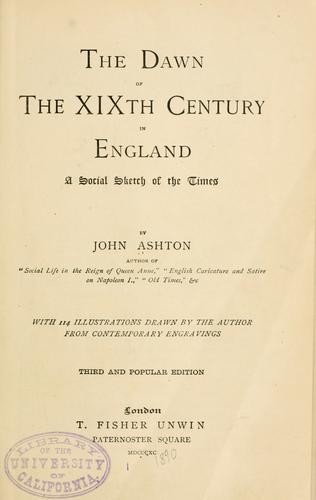
The Dawn of the XIXth Century in England: A social sketch of the timesAshton, John
History
The Dawn of the XIXth Century in England: A social sketch of the times
Ashton, John
England -- Social life and customs -- 19th century
The location of the Post Office has been changed many times. We are apt
to associate it with St. Martin’s-le-Grand, but it was not always so.
It was originally in Cloak Lane, near Dowgate, whence it was removed
to the Black Swan, in Bishopsgate Street; and, at the time of which we
write, it occupied the site of Sir Robert Vyner’s mansion, in Lombard
Street: that Sir Robert Vyner, who is historical, if only for his
treatment of his king, Charles II.—a story which is well told in No.
462 of the _Spectator_: “Sir Robert was a very loyal man, and, if you
will allow me the expression, very fond of his sovereign; out, what
with the joy he felt at heart for the honour done him by his prince,
and through the warmth he was in with the continual toasting healths
to the Royal Family, his lordship grew a little fond of His Majesty,
and entered into a familiarity not altogether so graceful in a public
place. The King understood very well how to extricate himself in
all kinds of difficulties, and, with a hint to the company to avoid
ceremony, stole off and made towards his coach, which stood ready for
him in Guildhall Yard. But the Mayor liked his company so well, and was
grown so intimate, that he pursued him hastily, and, catching him fast
by the hand, cried out with a vehement oath and accent, ‘Sir, you shall
stay and take t’other bottle.’ The airy monarch looked kindly at him
over his shoulder, and, with a smile, and graceful air, for I saw him
at the time, and do now, repeated this line of the old song:
‘_He that’s drunk is as great as a king_,’
and immediately returned back, and complied with his landlord.”
Then, as now, the Lombard Street Post Office was wasted. “It is
a national reproach when edifices of this kind, which, from our
great mercantile concerns, afford occasion for a display of public
architecture, and ornament to the Metropolis, are lost to those
purposes.” This was the comment of a contemporary, and the site of the
present Post Office in St. Martin’s-le-Grand was not fixed upon or,
rather, the first stone was not laid, till May, 1824. As now, the Post
Office was always changing its rules and rates—to meet emergencies
and keep abreast of the times—so that it would expand this notice to
too great a length, were I to chronicle all its changes. Perhaps a
short relation of its doings in 1804—which would be the mean of the
decade—will give as good an idea as any other.
Public-domain text, read in full here on John Shaqi.
Reviews
Reviews
No reviews yet
Be the first to share your thoughts on this work.
Elsewhere in the archive
Join the Discussion
Join the discussion
Sign in to leave a comment or review.
Sign InorCreate an account