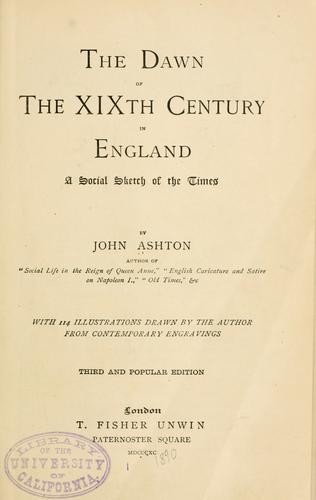
The Dawn of the XIXth Century in England: A social sketch of the timesAshton, John
History
The Dawn of the XIXth Century in England: A social sketch of the times
Ashton, John
England -- Social life and customs -- 19th century
“Houses, or boxes, for receiving letters before four o’clock, at
the West end of the town, and five o’clock in the City, are open in
every part of the Metropolis; after that hour bell-men collect the
letters during another hour, receiving a fee of _one penny_ for each
letter; but, at the General Post Office, in Lombard Street, letters
are received till seven o’clock; after that, till half an hour after
seven, a fee of _sixpence_ must be paid; and from half after seven till
a quarter before eight, the postage must be paid, as well as the fee
of _sixpence_. Persons, till lately, were, if well known, permitted to
have back any letter put in, if required; but, by an order of June,
1802, the masters of receiving houses are not allowed to return letters
on any pretence whatever.
“Letters from (? for) the East Indies must be delivered at the India
House, where a letter-box is provided for their reception.
“Those for the coast of Africa, or at single settlements in particular
parts of the world, may be sent either through the ship letter office,
or by the bags which await the sailing of ships, and which are kept at
the respective coffee houses near the Royal Exchange.”
We should consider these arrangements somewhat primitive; but then,
telegrams and frequent mails have spoilt us. The twopenny post was
mainly local, there being six deliveries and collections of letters in
town daily, and many country places had two deliveries and collections.
The letters were distributed throughout the length and breadth of the
country by means of _Mail Coaches_, which carried passengers at an
average rate of sixpence per mile. This system was inaugurated, and
organized, at the latter end of the Eighteenth Century, by a Mr. John
Palmer, of Bath, who not only suggested the routes, but to prevent
robbery, which, previously, was rife, had every coach accompanied by a
well-armed _guard_, and these coaches accomplished their journeys at a
uniform rate, including stoppages, of eight miles an hour. They did not
start from the Post Office, but from various inns, and the following is
a list of the coaches, and places of starting:
Dover }
Portsmouth } Angel, St. Clements.
Bristol }
Bath }
Exeter }
Liverpool }
Manchester } Swan with Two Necks, Lad Lane.
Norwich }
Taunton }
Yarmouth }
Ipswich }
Poole Bell and Crown, Holborn.
Chester and Holyhead }
Worcester } Golden Cross, Charing Cross.
Gloucester { Golden Cross, Charing Cross; and the
{ Angel, St. Clements, Strand.
York and Edinburgh }
Glasgow } Bull and Mouth, Bull and Mouth Street
Shrewsbury }
Leeds }
Harwich Spread Eagle, Gracechurch Street.
Public-domain text, read in full here on John Shaqi.
Reviews
Reviews
No reviews yet
Be the first to share your thoughts on this work.
Elsewhere in the archive
Join the Discussion
Join the discussion
Sign in to leave a comment or review.
Sign InorCreate an account