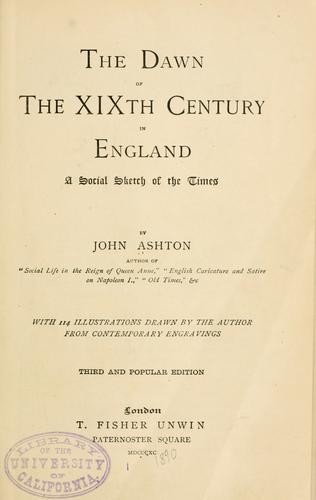
The Dawn of the XIXth Century in England: A social sketch of the timesAshton, John
History
The Dawn of the XIXth Century in England: A social sketch of the times
Ashton, John
England -- Social life and customs -- 19th century
Chichester }
Cambridge } Unknown.
Rye }
Brighton }
The letters were first of all sorted; then they were weighed, and their
proper amount of postage marked on them; they were counted, packed in
boxes for the different towns, and an account kept of their number;
they were then put in bags, which were sealed, and given in charge of
the mail guard. Postage was heavy in those days. Take the charges for
1810:
_d._
From any Post Office in England or Wales to any place not
exceeding 15 miles from such Office 4
For any distance above 15 miles, and not exceeding 30 miles 5
” 30 ” ” 50 ” 6
” 50 ” ” 80 ” 7
” 80 ” ” 120 ” 8
” 120 ” ” 170 ” 9
” 170 ” ” 230 ” 10
” 230 ” ” 300 ” 11
” 300 ” ” 400 ” 12
And so on in proportion, 1_d._ for every additional 100 miles.
London, at this time, was not beautiful. Apart from the public
buildings, its 160,000 houses (the number estimated in 1804) were not
lovely to look upon. Utilitarian they were, to a degree—long rows
of brick-built tenements, with oblong holes for windows. There was
no attempt at architecture: that had gone out with the first George;
and, during the first half of this century, domestic architecture in
this country was at its lowest possible ebb. Just fancy! in the first
decade, Baker Street was considered “perhaps the handsomest street in
London.” Can condemnation go further? All the houses were the same
pattern, varied only by the height of the rooms, and the number of
stories, which were mostly three, and very rarely exceeded four. There
was the front parlour, and the back parlour, a wretched narrow passage,
or hall, with a flight of stairs leading to the drawing-rooms. In the
basement were the kitchen and scullery.
[Illustration: TALES OF WONDER.]
Public-domain text, read in full here on John Shaqi.
Reviews
Reviews
No reviews yet
Be the first to share your thoughts on this work.
Elsewhere in the archive
Join the Discussion
Join the discussion
Sign in to leave a comment or review.
Sign InorCreate an account