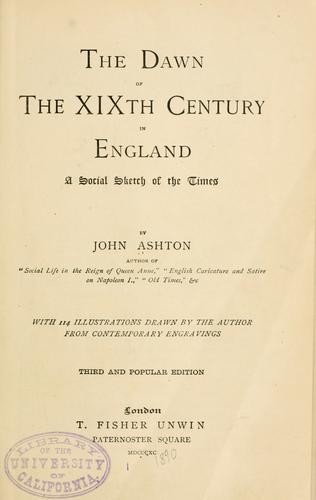
The Dawn of the XIXth Century in England: A social sketch of the timesAshton, John
History
The Dawn of the XIXth Century in England: A social sketch of the times
Ashton, John
England -- Social life and customs -- 19th century
PEOPLE, then, were conservative with regard to food. For the ordinary
Englishman was no appetizing _plat_, no refinement of cookery—anything
out of the usual ruck would be promptly denounced, and fiercely
spurned, as French _kickshaws_. Plain roast and boiled meats were
universal, from the highest to the lowest; the quantity of animal food
consumed throughout the country was enormous; and, what was more, it
was all of home production. No frozen meat, no tinned provisions;
the only known way of preserving then, was the time-honoured one of
salting. In London alone, according to the very meagre statistics of
the day, the number of bullocks slaughtered yearly was 110,000; of
sheep and lambs 776,000; calves 210,000; hogs 210,000; sucking pigs,
60,000; besides an unknown quantity of animals of other kinds. This
may be an approximate estimate of the number, based, probably, on the
quantity sold at the various markets to the butchers, but can give us
no idea of the weight, and consequent average consumption per head.
Fish was scarce, and dear; the war, naturally, prevented the fishermen
from going far from the coast, and their numbers, moreover, were
thinned by impressment. No railways to bring this very perishable
commodity quickly to market, no ice to preserve it on its journey;
the smack must go to port to unload her cargo, and, being entirely
dependent on her sails, was at the mercy of the winds.
Inland, they never knew the taste of salt-water fish, unless some
kind friend sent a cod, or turbot, packed in straw, in a basket, as a
present by the mail, or stage, coach. Nor could the Londoner, then, get
the abundant supply of our salmon rivers, which he now, in common with
the whole of England, enjoys.
Game was very scarce, and dear. A country gentleman would not have
dared to brave the public opinion of his county, by selling his game,
and battues were unknown. The poachers did, undoubtedly, a good trade;
and about Christmas time the mail, and stage, coaches came up, loaded
with hares, &c.—a fact amusingly chronicled in the _Morning Post_ of
the 26th of December, 1807: “The first of the Norwich and Yarmouth
coaches arrived at a late hour on Thursday, when, strange to relate,
every one of the passengers, inside and outside, were found _dead_! Not
less than four hundred brace of _dead game_ being unloaded from it, for
the banqueting of the _living Londoners_ at this luxurious season.” If,
however, a story told in the _Times_ of the 20th of January, 1803, is
true, it was not always safe to buy game from the coaches: “Saturday
night last, an epicure from Fish Street Hill, anxiously watched for
the arrival of a Kentish coach, at the King’s Head, in the Borough,
in order to purchase a _Hare_ from the coachman, for his Sunday’s
dinner; an outside passenger, having learned his errand, brought him
under the gateway, and sold him a very large one, as he thought, for
nine shillings, which, however, upon his return home, proved to be a
_badger_.”
Public-domain text, read in full here on John Shaqi.
Reviews
Reviews
No reviews yet
Be the first to share your thoughts on this work.
Elsewhere in the archive