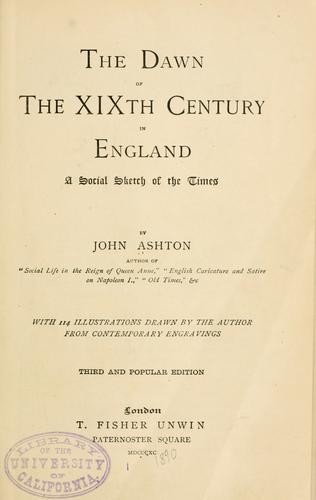
The Dawn of the XIXth Century in England: A social sketch of the timesAshton, John
History
The Dawn of the XIXth Century in England: A social sketch of the times
Ashton, John
England -- Social life and customs -- 19th century
Poultry was seldom seen except at the tables of the very well to
do. The supply was deficient, and they had not the resources we
have of railway carriage, and especially of the Continental markets;
consequently prices were exorbitant. Venison was considered _the_ dish
for an epicure, and was sold—chiefly by pastry cooks—at a reasonable
rate: in fact, there were coffee houses where a venison dinner could
be obtained for 2s. 6d. Probably the following advertisement indicates
a somewhat better style of entertainment—_Morning Herald_, July 18,
1804: “VENISON in perfection. At the Worcester Coffee House, corner
of Swallow Street, Oxford Street, Gentlemen may depend on having
prime Venison. A Haunch and Neck dressed every day, ready precisely
at five o’clock, at the reasonable charge for dinner of 3s. 6d. Wines
and Liquors of the finest flavour; best old Port 4s. 6d. per bottle.
Venison ready dressed, and pasties sent out. N.B. Fifty brace of good
Bucks wanted.”
It was an age of eating and drinking—_i.e._, men ate and drank in
larger quantities than now; but we must not take the following as a
typical feast of the time; it was simply a brewer’s dinner, cooked
after a brewer’s fashion—yet it was also typical, for then the cult
of beefsteak and porter was at its culminating point, and people bowed
down, and reverenced them exceedingly. The _Morning Post_, May 30,
1806: “Alderman Combe’s Annual Dinner. Yesterday, Mr. Combe gave his
annual dinner at his brewery, near Long Acre. The party consisted
of the Prince of Wales, Duke of Norfolk, Lord Chancellor, Earl of
Lauderdale, Lord Robert Spencer, Lord Howick, Sir Gilbert Heathcote,
Lord John Townshend, Mr. R. B. Sheridan, Mr. Tierney, Mr. Harvey Combe,
and Mr. Alderman Combe. At half an hour past six, the company sat down
to dinner. The entertainment consisted of beefsteaks and porter. It was
served up in the same style as it was last year. An oaken table, of an
oblong form, was set out in the long room of the brewhouse. This table
was covered with a large hempen sack, and covers, consisting of wooden
trenchers, were laid for each of the guests. The other paraphernalia
of the table, namely, the spoons, salt-cellars, salad bowls, &c., were
composed of the same material as the plates. The Steaks were cooked by
_the Stoker_, a man so called from his being always employed to keep
the fires. This Stoker dressed the Steaks upon a large plate of iron,
which was placed in the Copper-hole. When done, the Cook took them out
with a pair of tongs, conveyed them into a wooden dish, and, in that
style, they were served up. At the expiration of half an hour, the
Prince, and the company, retired to Mr. Combe’s house, in Great Russell
Street, Bloomsbury, where they partook of a second course, consisting
of every delicacy of the season, together with a dessert of fruits, the
most rare and abundant we have ever seen. The Madeira, Port, and Claret
were the objects of every one’s panegyric.”
Public-domain text, read in full here on John Shaqi.
Reviews
Reviews
No reviews yet
Be the first to share your thoughts on this work.
Elsewhere in the archive
Join the Discussion
Join the discussion
Sign in to leave a comment or review.
Sign InorCreate an account