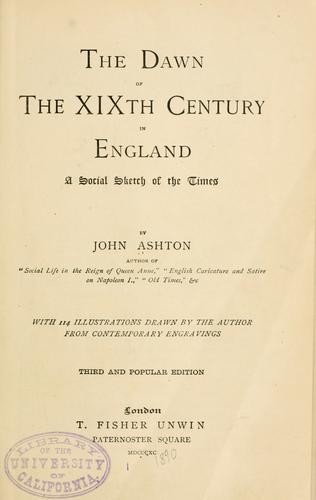
The Dawn of the XIXth Century in England: A social sketch of the timesAshton, John
History
The Dawn of the XIXth Century in England: A social sketch of the times
Ashton, John
England -- Social life and customs -- 19th century
Beef averaged from 6d. to 9½d. per lb.
Mutton ” 6d. to 10d. ”
Pork ” 6d. to 1s. ”
Lamb at first coming in 10d. to 1s. 2d. ”
” Mid Season 6½d. to 8d. ”
Sugar was about 5d. to 5½d. ”
Salt ” 20s. per bushel.
Store Candles about 1s. 3d. per lb.
Whilst on the subject of food, I cannot help chronicling the first
notices I have ever met with, of two articles familiar to us—Sardines,
and Harvey’s Sauce. The first occurs in an advertisement in the
_Morning Post_, August 10, 1801: “SARDINIAS, a Fish cured in a peculiar
manner, are highly esteemed as a Sandwich, and deemed of superior
flavour to the Anchovy. Sold,” &c. The second is in the _Morning
Herald_, February 9, 1804: “HARVEY’S Sauce for Fish, &c. Black Dog,
Bedford. Mr. Harvey respectfully informs the Nobility and Gentry, he
has appointed Mrs. Elizabeth Lazenby to prepare and sell the above
sauce, at her Oil Warehouse, No. 6, Edward’s Street, Portman Square,
and that she, alone, is in possession of the original receipt—signed
Peter Harvey.”
If, however, the times were somewhat gross feeding, yet, early in the
century, they also knew the pinch, if not of absolute hunger, yet of
that which comes nigh akin to it—scarcity. As we have seen in the
History of the decade, bread stuffs were, through bad harvests, very
dear; and the strictest attention to economy in their use, even when
mixed with inferior substitutes, practised. The unreasoning public laid
the whole of the rise in price on the shoulders of the middle-men,
or factors; and they were branded with the then opprobrious, but now
obsolete, term of “Forestallers and Regraters.” Take one plaintive
wail, which appeared in the _Morning Post_ of March 7, 1800: “We are
told that one cause of the high price of Corn is, the consequence of
the practice of selling by sample, instead of the Corn being fairly
brought to market. The middle-man buys the Corn, but desires the
farmer to keep it for him, until he wants it; or, in other words,
until he finds the price suits his expectations.” This rage against
“forestalling” was, of course, very senseless; but it had the advantage
of being applied indiscriminately, and to every description of food.
Two women at Bristol were imprisoned for “forestalling” a cart load of
mackerel; whilst the trial of Waddington for “forestalling” _hops_
is almost a _cause célèbre_. Now, hops could hardly be construed into
food; and, after having carefully read his trial, I can but come to
the conclusion that he was a very hardly-used man, and was imprisoned
for nothing at all.[43] I merely mention his case as a proof of
the senseless irritation which the price of food caused upon the
unreasoning public.
Public-domain text, read in full here on John Shaqi.
Reviews
Reviews
No reviews yet
Be the first to share your thoughts on this work.
Elsewhere in the archive
Join the Discussion
Join the discussion
Sign in to leave a comment or review.
Sign InorCreate an account