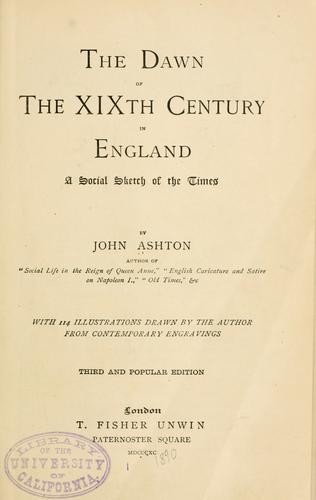
The Dawn of the XIXth Century in England: A social sketch of the timesAshton, John
History
The Dawn of the XIXth Century in England: A social sketch of the times
Ashton, John
England -- Social life and customs -- 19th century
Food had to be looked for anywhere. The Continent was no field for
speculation; a bad harvest had been universal; and, besides, we
were at war. Then, for the first time, was India drawn upon for our
food supply, and the East India Company—that greatest marvel of
all trade—offered every facility towards the export of rice. Their
instructions were as follow: “That every ship, which takes on board
three quarters of her registered tonnage in rice, shall have liberty
to fill up with such goods as have been usually imported by country
ships. That ships embarking in this adventure shall be allowed to carry
out exports from this country. That they shall be excused the payment
of the Company’s duty of 3 per cent., on the rice so imported. That,
after the ship shall have been approved by the Company’s surveyors, the
risk of the rice which she brings, shall be on account of Government,
which will save the owners the expense of insurance. That, in case
the price of rice shall, on the ships’ arrival, be under from 32s. to
29s. the hundredweight, the difference between what it may sell for,
and the above rates shall be made good to the owners, on the following
conditions—That the ship which departs from her port of lading, within
one month from the promulgation of these orders, shall be guaranteed
32s. the hundredweight; if in two months, 31s.; if in three months,
30s.; and if in four months, 29s. But, that dependence may be safely
placed on the rice being of superior quality, that is, equal, at
least, to the best cargo of rice, it shall be purchased by an agent
appointed by Government. Coppered ships to be preferred, and, although
Convoy[44] will, if possible, be obtained for them, they must not be
detained for Convoy.”
[Illustration]
[Illustration]
CHAPTER XXIX.
Parliamentary Committee on the high price of provisions—Bounty on
imported corn, and on rice from India and America—The “Brown Bread
Bill”—Prosecution of bakers for light weight—Punishment of a butcher
for having bad meat—Price of beef, mutton, and poultry—Cattle
shows—Supply of food from France—Great fall in prices here—Hotels,
&c.—A clerical dessert.
PARLIAMENT bestirred itself in the matter of food supply, not only in
appointing “a Committee to consider the high price of provisions,” who
made their first report on the 24th of November, 1800; but Mr. Dudley
Ryder (afterwards Earl of Harrowby) moved, on the 12th of November, in
the same year, the following resolutions, which were agreed to:—
“1. That the average price at which foreign corn shall be sold in
London, should be ascertained, and published, in the _London Gazette_.
Public-domain text, read in full here on John Shaqi.
Reviews
Reviews
No reviews yet
Be the first to share your thoughts on this work.
Elsewhere in the archive
Join the Discussion
Join the discussion
Sign in to leave a comment or review.
Sign InorCreate an account