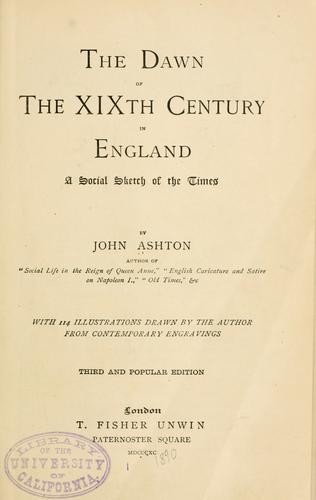
The Dawn of the XIXth Century in England: A social sketch of the timesAshton, John
History
The Dawn of the XIXth Century in England: A social sketch of the times
Ashton, John
England -- Social life and customs -- 19th century
At all the clubs, gaming was practised more or less. _Morning Herald_,
June 16, 1804: “A noble Lord, lately high in office, and who manifests
a strong inclination to be reinstated in his political power, lost at
the UNION, a night or two back 4,000 guineas before twelve o’clock;
but, continuing to play, his luck took a turn, and he rose a winner of
a thousand before five the next morning.”
Again, to show the large sums then won and lost at gambling, take the
following newspaper cuttings.
_Morning Post_, June 30, 1806: “The Marquis of H———— d is said to have
been so successful at play this season, as to have cleared £60,000. The
Earl of B———— e has won upwards of £50,000, clear of all deductions. A
Right Reverend is stated to be amongst those who are _minus_ on this
occasion.”
_Morning Post_, July 8, 1806: “A certain noble Marquis, who has been so
very fortunate this season in his gaming speculations, had a run of ill
luck last week. At one sitting, his lordship was _minus_ no less a sum
than _thirteen thousand pounds_!”
_Morning Post_, July 15, 1806: “The noble Marquis, who has been so
great a gainer, this season, at _hazard_, never plays with any one,
from a PRINCE, to a _Commoner_, without having the stakes _first_ laid
on the table. His lordship was always considered as a _sure card_,
but now his fame is established, from the circumstance of his having
cleared £35,000, after deducting all his losses for the last six
months.”
But, although the magistrates shut their eyes to the sins of the great,
and punished the small, when brought before them, the Government
systematically demoralized the people by means of lotteries. True,
it was a great temptation, for it yielded a revenue to the State of
about £350,000, besides the licenses of the brokers, £50 each. Very
jealous was the Government to protect its children from the pernicious
effects of private lotteries; they were _anathema_, and, besides, they
would absorb some of the profit, which otherwise would have gone into
the pockets of a paternal rule. In this decade, there were but two
private lotteries, and, for both of them, a special act of Parliament
was required, viz., that of the Pigot diamond in 1800, and Boydell’s
pictures in 1805.
This illustration is by Pyne, and, like all his drawing, is extremely
graphic. It represents the Life Guards, who then had to perform many of
the duties of our police, conveying the Lottery wheels, from Somerset
House (or Somerset Place, as it was then called) to Cooper’s Hall, in
Basinghall Street, where the Lottery was then drawn. There were four
sledges employed for the purpose, two carrying the wheels containing
the tickets, with their blanks, or prizes, and the other two bore the
cases for the wheels. They were drawn by three horses each.
[Illustration: LIFE GUARDS ESCORTING A LOTTERY WHEEL.]
Public-domain text, read in full here on John Shaqi.
Reviews
Reviews
No reviews yet
Be the first to share your thoughts on this work.
Elsewhere in the archive
Join the Discussion
Join the discussion
Sign in to leave a comment or review.
Sign InorCreate an account