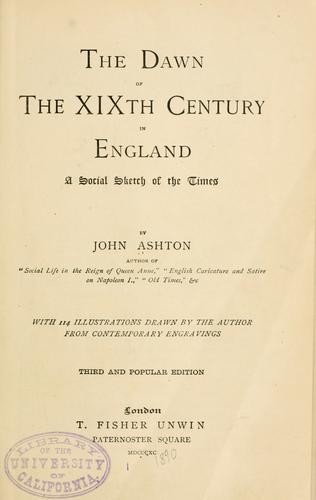
The Dawn of the XIXth Century in England: A social sketch of the timesAshton, John
History
The Dawn of the XIXth Century in England: A social sketch of the times
Ashton, John
England -- Social life and customs -- 19th century
For many years the Lottery had been drawn at Guildhall, but it was
afterwards removed to Cooper’s Hall. At both places the tickets were
drawn out of the wheels by two scholars of Christ’s Hospital, or
Bluecoat boys—who were thus selected for this office because their
youth, and supposed integrity,[52] rendered them less liable than
other boys, to be tampered with. The accompanying illustration gives a
very life-like presentment of the scene.
The last public Lottery, in England, was drawn in October, 1826.
[Illustration: DRAWING THE LOTTERY AT COOPER’S HALL.]
Needless to say that Gambling, either in the form of card playing,
dicing, or lotteries, was not the only way that fools and rogues could
throw away their money. Still there were two resources left—the Turf,
and Cock-fighting. The Turf was undoubtedly purer then than now,
when it has reached such a pitch of refinement in blackguardism, and
scoundrelism, that it must soon either be swept away, or violently
reformed. Racing then was more for encouraging a breed of horses,
swift, yet of such staying powers as to be able to run a four-mile heat
without breaking down: not like our “exaggerated greyhounds,” who can
barely stagger over a course of six furlongs, or three quarters of a
mile.
The stakes were not so high, and although there was much betting on
a race, yet it was among the upper class, or men who could afford to
lose to each other, and in the society of their equals; and not as at
present, when a lord is on familiar terms with a ruffian, so long as
he will give the odds required, and may possibly be able to pay if he
loses; nor, then, did shop boys make books on races, or talk learnedly
of double events, &c., and such scenes as can now be witnessed any race
day in Fleet Street, were utterly unknown, and undreamt of. A King’s
plate of £100 was then considered worth running for, and noblemen, and
gentlemen, matched their horses one against the other, in a proper
spirit of emulation.
There was a fair amount of racing literature—“Baily’s Racing
Register,” “Pick’s Racing Calendar,” “The Turf Register,” “The Racing
Calendar,” and “The Sporting Magazine,” and I know, and care not,
whether this is an exhaustive list. From some of them we get some
curious names of race horses, for their owners then, seem to have run
riot in the nomenclature of their animals. What should we say nowadays
to such names as “Kiss in a Corner,” “Jack, come tickle me,” “Jenny,
come tye me,” “I am little, pity my condition,” “Jack’s my favourite,”
“Britons, strike home,” “Why do you slight me?” “Turn about, Tommy,”
“Sweeter when clothed,” “Watch them and Catch them,” “First time of
Asking,” “Fear not, Victorious,” “Hop, step, and jump,” &c., &c.
Public-domain text, read in full here on John Shaqi.
Reviews
Reviews
No reviews yet
Be the first to share your thoughts on this work.
Elsewhere in the archive
Join the Discussion
Join the discussion
Sign in to leave a comment or review.
Sign InorCreate an account