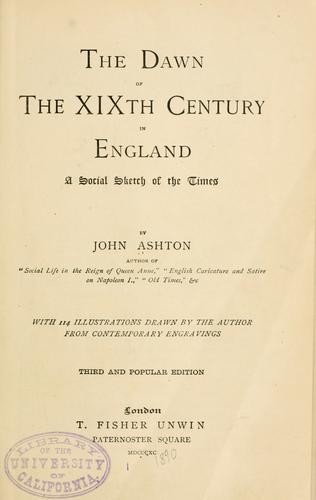
The Dawn of the XIXth Century in England: A social sketch of the timesAshton, John
History
The Dawn of the XIXth Century in England: A social sketch of the times
Ashton, John
England -- Social life and customs -- 19th century
Another cruel, yet intensely national sport, was Bull-baiting. Hardly
a country town of note but had its “Bull-ring”; and, although the bull
had but a circumscribed range, being tied by a rope to a stake, yet the
dogs did not always get the best of the combat, and many a tyke met
his death, or went a limping cripple for the remainder of his days. I
have already noted one bull-baiting in the account of the _Jubilee_
rejoicings at Windsor in October, 1709, and that must suffice.
A few years previously it had been made the subject of a debate in
the House of Commons, where much special pleading in its favour was
exhibited. On May 24, 1802,[53] Mr. John Dent, M.P. for Lancaster,
moved that the Bill to prevent Bull-baiting and Bull-running be read a
second time. Sir Richard Hill pleaded the cause of the poor bulls, not
very eloquently, but as earnestly as he could. He pointed out that an
Act had been passed for the abolition of Bull-baiting in Ireland, and
he called upon the Irish members to support this Bill.
Then up rose the Right Hon. W. Windham, M.P. for Norwich, and he
contended that the cruelty was no greater than that comprised in the
sports of hunting, shooting, and fishing. “If the effects of one were
to be viewed through the medium of a microscope, why were not the
consequences of the other to be scrutinized with equal severity?” In
the course of a long speech he warmed to his view of the subject,
until, at last, in the fervour of his eloquence, he burst into the
following: “He believed that the bull felt a satisfaction in the
contest, not less so than the hound did when he heard the sound of the
horn which summoned him to the chase. True it was, that young bulls,
or those that were never baited before, showed reluctance to be tied
to the stake; but those bulls, which, according to the language of the
sport, were called _game_ bulls, who were used to baiting, approached
the stake and stood there, while preparing for the contest, with the
utmost composure. If the bull felt no pleasure, and was cruelly dealt
with, surely the dogs had also some claim to compassion; but the fact
was, that both seemed equally arduous in the conflict; and the bull,
like every other animal, while it had the better side, did not appear
to feel unpleasantly; it would be ridiculous to say he felt no pain;
yet, when on such occasions he exhibited no sign of terror, it was a
demonstrable proof that he felt some pleasure.”
Mr. Courtenay rose to a much greater height. Said he: “What a glorious
sight to see a dog attack a bull! It animates a British heart—
‘To see him growl, and snap, and snarl, and bite,
Pin the bull’s nose, and prove instinctive might.’
Public-domain text, read in full here on John Shaqi.
Reviews
Reviews
No reviews yet
Be the first to share your thoughts on this work.
Elsewhere in the archive
Join the Discussion
Join the discussion
Sign in to leave a comment or review.
Sign InorCreate an account