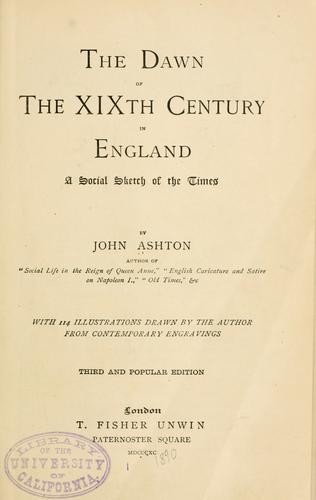
The Dawn of the XIXth Century in England: A social sketch of the timesAshton, John
History
The Dawn of the XIXth Century in England: A social sketch of the times
Ashton, John
England -- Social life and customs -- 19th century
Besides, if bull-baiting was given up, the characteristic of our
British dogs, so classically celebrated in the Augustan age of
literature, would be totally lost. Claudian says: ‘Magnaque taurorum
fracturæ colla Britannæ.’ Symmachus mentions seven Irish bull-dogs:
‘Septem Scottici canes,’ as then first produced in the circus at Rome,
to the great admiration of the people.’”
General Gascoyne considered it an amusement which the lower orders were
entitled to; and it was “with regret he observed a disposition in many
of the members to deprive the poor of their recreations, and force them
to pass their time in chaunting at conventicles.”
Then the gentle William Wilberforce rose, and rebuked the former
speakers, telling them that he thought the subject had been treated
with too much levity. “The evidence against the practice was derived
from respectable magistrates. From such evidence he had derived a
variety of facts, which were too horrid to detail to the House.
A bull—that honest, harmless, useful animal—was forcibly tied
to a stake, and a number of bull-dogs set upon him. If he was not
sufficiently roused by the pain of their attacks, the most barbarous
expedients were hit upon to awake in him that fury which was necessary
to the amusement of the inhuman spectators. One instance of the latter
kind he would state. A bull had been bought for the sole purpose of
being baited; but, upon being fixed to the stake, he was found of so
mild a nature that all the attacks of the dogs were insufficient to
excite him to the requisite degree of fury; upon which those who bought
him refused to pay the price to the original owner, unless he could be
made to serve their purposes: the owner, after numberless expedients,
at last sawed off his horns, and poured into them a poignant sort of
liquid, that quickly excited the animal to the wished-for degree of
fury. When bulls were bought merely for the purpose of being baited,
the people who bought them wished to have as much diversion (if
diversion, such cruelty could be called) as possible, for their money.
The consequence was that every art, even fire, had been employed to
rouse the exhausted animal to fresh exertions, and there were instances
where he had expired in protracted agonies amidst the flames. It had
been said, that it would be wrong to deprive the lower orders of their
amusements, of the only cordial drop of life which supported them under
their complicated burthens. Wretched, indeed, must be the condition of
the common people of England, if their whole happiness consisted in the
practice of such barbarity!”
Sheridan joined Wilberforce; but the Bill was thrown out by 64 to 51;
and the practice of Bull-baiting was only declared illegal in 1835,
when it was included in the Act against Cruelty to Animals, 5th and 6th
William IV., cap. 59.
Public-domain text, read in full here on John Shaqi.
Reviews
Reviews
No reviews yet
Be the first to share your thoughts on this work.
Elsewhere in the archive
Join the Discussion
Join the discussion
Sign in to leave a comment or review.
Sign InorCreate an account