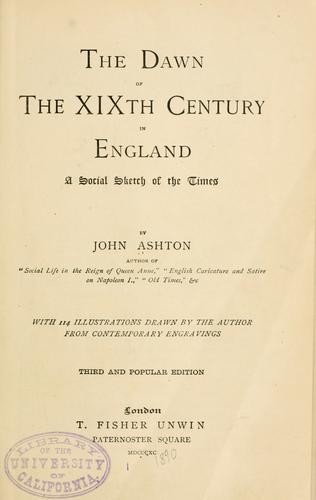
The Dawn of the XIXth Century in England: A social sketch of the timesAshton, John
History
The Dawn of the XIXth Century in England: A social sketch of the times
Ashton, John
England -- Social life and customs -- 19th century
There was yet another brutal sport, not wholly unconnected with money
and betting, which was then at its apogee, and that was Prize-fighting.
This decade was at its Augustan period, when the ruffians, who mauled
each other for lucre’s sake, were petted and fêted as much as ever
were the gladiators in the time of Rome’s decline—the names of the
pugilists then living being those of the greatest renown in the history
of the prize ring. Even people who are not tainted with a love of the
“Noble Art of Self-defence” must have heard of Jem Belcher, John Gully,
page to George IV., and M.P. for Pontefract; Dutch Sam, Tom Crib, and
his black adversary Thomas Molineaux; these names are as familiar to
every schoolboy as those of the Homeric heroes. It was an age of
muscle, not of brains; and the use of the fists was encouraged as the
arbiter in disputes which nothing but a little blood-letting could
appease, in preference to the duels, or to that utter abhorrence of all
Englishmen—the knife.
Doubtless, boxing is commendable in many ways, and should form part
of every man’s physical education, not only to the great advantage of
his muscular system, and consequent good health, but, should occasion
ever require the use of his fists, he is armed at once with weapons in
whose use he is well trained; but that is very different from two men,
possibly very good friends, spending long months in getting themselves
in the best possible physical condition for pounding each other into
a mass of bruised jelly, in order to put some money in their pockets,
and afford sport and amusement to a parcel of debased brutes, whatever
their social position might be.
The Prince of Wales in his younger days was, to a small extent, a
“Patron of the Ring,” _i.e._, he once went to a meeting which took
place at Smitham Bottom, near Croydon, on June 9, 1788, where he saw
three fights, one between the celebrated John Jackson—whose beautiful
tomb is in Brompton Cemetery—and Fewterel, of Birmingham; and, on
Jackson’s winning, he sent him, by the hand of his friend, Colonel
Hanger, a bank-note. The next fight was between Stephen Oliver,
nicknamed “Death,” with a Jew, named Elisha Crabbe, which ended in
“Death’s” defeat; and the third encounter was between two outsiders.
Again he was present at three fights which took place on the Brighton
race-course, on August 6, 1788. In the third—which was between
Tom Tyne, “the Tailor,” and Earl—Tyne hit his opponent a sharp,
left-handed blow on the side of the head, which drove him against
the rail of the stage. He fell insensible, and expired very shortly
afterwards. The Prince of Wales openly expressed his determination to
never again witness a prize-fight—and this he kept—also to settle
an annuity on Earl’s widow and children; but history is silent as to
whether this was ever carried out.
Public-domain text, read in full here on John Shaqi.
Reviews
Reviews
No reviews yet
Be the first to share your thoughts on this work.
Elsewhere in the archive
Join the Discussion
Join the discussion
Sign in to leave a comment or review.
Sign InorCreate an account