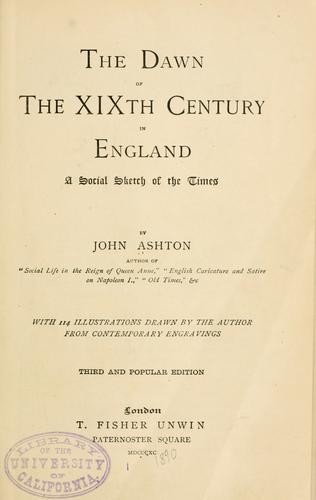
The Dawn of the XIXth Century in England: A social sketch of the timesAshton, John
History
The Dawn of the XIXth Century in England: A social sketch of the times
Ashton, John
England -- Social life and customs -- 19th century
“It is generally believed, however, that he has played for more money
at billiards than any other person ever did. The following is a
remarkable circumstance: he, one night, won of Col. W———— e upwards
of £1,000, and the Colonel appointed to meet him the next day to go
with him to the City, to transfer Stock to him for the amount of the
sum lost. Being in a hackney coach, they tossed up who should pay for
it. Andrews lost, and upon this small beginning he was excited to
continue, till he had lost the whole sum he had won the night before
at billiards. When the coachman stopped to get down, he was ordered to
get up again, and drive them back, as they had no occasion to get out.
“By these pursuits he lost very large sums which he had won at
billiards; and, in a few years, hazard, and other games of chance,
stripped him of every shilling he could command. He had still left
a small annuity which he endeavoured to dispose of, but it was so
securely settled upon himself that he could not sell it; otherwise it
is probable that it would soon have been transferred at the gaming
table. He very lately lived in a retired manner in Kent, where he
declared to an intimate old acquaintance that he never knew contentment
when he was rolling in money; but, since he was obliged to live upon
a scanty pittance, he thought himself one of the happiest men in the
universe.”
[Illustration]
[Illustration]
CHAPTER XXXVIII.
The Theatre—Number of theatres in London—Famous actors and
actresses—Disturbances at a theatre—Master Betty, “The Infant
Roscius”—His country experience—Puffs preliminary—His first
appearance in London—Crowds to see him—Presented to the King and the
Prince of Wales—Acts at Drury Lane—His subsequent career.
IN THE Dawn of the Nineteenth Century, the theatre was a favourite
amusement for the good folks, probably because there were no other
public forms of amusement, if we except an occasional concert or
masquerade. The stage supplied this want, and the people took due
advantage of it. The audience, through much frequenting, were
critically educated, and demanded good acting. This, as a rule, they
obtained, partially, as I think, because there were fewer actors, and,
consequently, not so many mediocre performers as now, and partly owing
to the constant change of performance—there being no “long runs,”
as we know them, where an actor mechanically goes through the same
part for hundreds of nights, until, like Sothern, he absolutely, and
unconsciously, adopts his own mannerisms, and spoils himself for a
fresh part.
The richer, and titled classes, were not content with witnessing
professional skill, but strove to emulate and surpass the performers at
their own amateur entertainments, and the most notable of these private
societies was the Pic Nic Society.
Public-domain text, read in full here on John Shaqi.
Reviews
Reviews
No reviews yet
Be the first to share your thoughts on this work.
Elsewhere in the archive
Join the Discussion
Join the discussion
Sign in to leave a comment or review.
Sign InorCreate an account