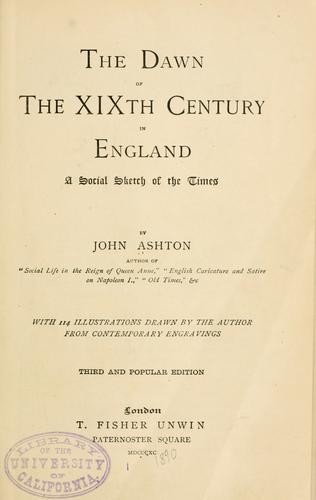
The Dawn of the XIXth Century in England: A social sketch of the timesAshton, John
History
The Dawn of the XIXth Century in England: A social sketch of the times
Ashton, John
England -- Social life and customs -- 19th century
There were eight Theatres in London, _i.e._, when one or other was not
burnt down—namely, The King’s, Haymarket; Covent Garden; Drury Lane;
Theatre Royal, Haymarket; The Royalty, in Goodman’s Fields; Sadlers
Wells; Astley’s; and the Royal Circus, now the Surrey, on the other
side the river.
Of course, as would be only natural, the best actors were at the
West-end Theatres, and to show their calibre, one has only to mention
such names as John Philip Kemble, Munden, Bannister, Dowton, Elliston,
Liston, Mrs. Siddons, Fawcett, Mrs. Jordan, Kelly, Johnstone, Young,
Cooke, &c. No wonder, that with such actors, the stage was popular.
Their names are still a tradition of excellence to the profession, and
the performances, with one notable exception, in the O. P. Riots, were
listened to with great decorum, and there was a vast improvement upon
the rougher manners of the previous century.
I can only find the mention of one _fracas_ in the whole ten years,
and the report of that, in the _Annual Register_, December 26, 1801,
shows how very far the audience were from sympathizing with the
offender. “At Covent Garden Theatre the holiday folks were inclined
to be mischievous. As soon as the curtain drew up to commence the
play of ‘Richard the Third,’ a wine glass was thrown on the stage by
way of prologue, but without exciting much observation; a few minutes
after, determined to attract notice, a quart bottle was thrown from the
two-shilling gallery on the stage; it grazed the hat of Mr. Betterton,
who was playing Tressel to Murray’s Henry VI., knocked out some of the
jewels, and, falling on the stage, rolled down to the lamps unbroken.
The audience were thunderstruck, the play stood still, and, for a few
seconds, every one gazed with amazement. Satisfied of what had been
done, a general burst of indignation broke out over the house, and
‘throw him over!’ ‘turn him out!’ were vociferated from all quarters.
The villain was pointed out by his neighbours, sitting in the front
row of the two-shilling gallery. He was seized, the people in the pit,
and the boxes, rising up, and considerable agitation prevailed. The
fellow, who was drunk, held by the iron railing, and refused to retire.
This provoked the resentment against him still more, and the cries of
vengeance were loud and general. Three or four laid hold of him, and
seemed as if they would drag rail and all away; at last, they succeeded
in taking him out of the theatre.”
Public-domain text, read in full here on John Shaqi.
Reviews
Reviews
No reviews yet
Be the first to share your thoughts on this work.
Elsewhere in the archive
Join the Discussion
Join the discussion
Sign in to leave a comment or review.
Sign InorCreate an account