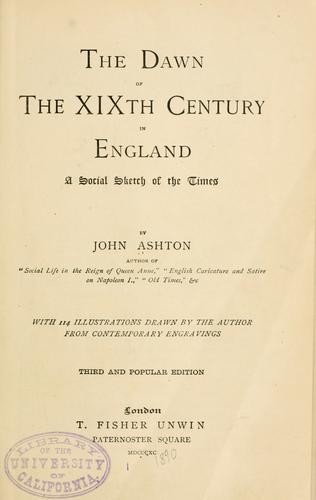
The Dawn of the XIXth Century in England: A social sketch of the timesAshton, John
History
The Dawn of the XIXth Century in England: A social sketch of the times
Ashton, John
England -- Social life and customs -- 19th century
In this decade appeared a theatrical phenomenon—the like of which
has never been seen since; in the shape of a boy, who was endowed
with a truly marvellous gift of acting—one Master William Henry West
Betty, surnamed “The Infant Roscius,” who was born at Shrewsbury,
September 13, 1791. His parents were extremely respectable, and in
easy circumstances—so that it was not from need, but from pure
inclination, that he adopted the stage as a profession. Whilst yet
a child, he was fond of declamation with action, and, before he was
twelve, he acted the part of Osman in Voltaire’s tragedy of Zara, at
the Theatre, Belfast. He was, at that time, residing in Ireland, and
the theatres, having been closed for some time previously, owing to
the disturbed state of the country, were glad of any attraction when
they did open—so Betty took an engagement at the above theatre, for
four nights, on the understanding that he was to share the house, after
deducting twelve pounds, for the expenses of the house. His first
performance was on the 19th of August, 1803, when he was not yet twelve
years old. Next day he was the talk of Belfast, and on the other three
nights he played Norval, Rolla, and Romeo.
Then he went to Dublin, Cork, Glasgow, Edinburgh, and Birmingham, at
which latter place he was heard by Mr. Justice Graham, one of the Board
of Management of Drury Lane Theatre. He reported about the infant
genius, and proposals were made, which were too low to be acceptable.
He was afterwards engaged to play at Covent Garden, and, owing to
an informality in the agreement, Drury Lane got hold of him on the
intervening nights, at the same salary.
[Illustration: THE YOUNG ROSCIUS, AS FREDERICK, IN “LOVERS’ VOWS.”]
Whoever was his _entrepreneur_, he did his work well, and the puff
preliminary was very delicately administered. The first notice of this
kind that I can find, is in the _Morning Herald_, August 6, 1804. “A
very extraordinary phenomenon has lately burst upon the _theatrical_
world. A boy of the name of Beatie, not exceeding twelve years of age,
reads and enacts all the principal of Shakespeare’s characters, in a
stile of superiority that astonishes the most experienced Actors. He
has performed in Ireland, and is now exciting general astonishment at
Edinburgh. Off the stage his manners are puerile, as he is often seen
playing at marbles in a morning, and Richard the Third in the evening.
He is rather short of his age, slight made, but has great expression of
countenance. The moment he begins to converse upon stage business, he
appears an inspired being. He has a pleasant turn for repartee, which
makes his company much sought for. The Edinburgh Manager expressed his
fears, at first rehearsal, that his voice would not fill the house. ‘My
dear Sir,’ replied the little hero of the buskin, ‘I beg you will be
under no apprehensions upon that score, for, if my voice does not fill
your house, probably my playing will!’”
Public-domain text, read in full here on John Shaqi.
Reviews
Reviews
No reviews yet
Be the first to share your thoughts on this work.
Elsewhere in the archive
Join the Discussion
Join the discussion
Sign in to leave a comment or review.
Sign InorCreate an account