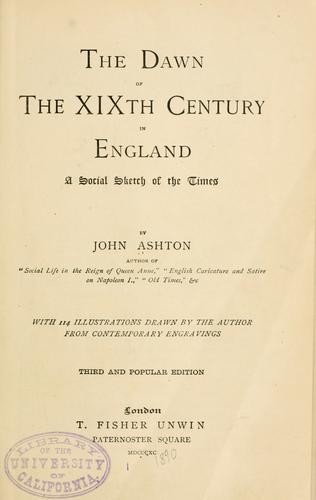
The Dawn of the XIXth Century in England: A social sketch of the timesAshton, John
History
The Dawn of the XIXth Century in England: A social sketch of the times
Ashton, John
England -- Social life and customs -- 19th century
She came on the stage again, but the audience would not listen to
her, and Miss Searle had to finish her part. What became of this
self-possessed child I know not; according to the _Morning Post_, April
5, 1806, she joined a children’s troupe in Leicester Place, where,
“though deservedly discountenanced at a great theatre, she will, no
doubt, prove an acquisition to the infant establishment.”
Late in the last century, the literary and theatrical world had been
thrown into a state of high excitement, by the announcement of the
discovery of an original play by Shakespeare, called “Vortigern and
Rowena,” which was acted at Drury Lane, and condemned, as spurious,
the first night; but belief in it lasted for some time, and the
question was of such importance, that the _Morning Post_, in 1802, took
the suffrages of the fashionable world, as to its authenticity. The
question was set at rest in 1805 by the forger himself, one William
Henry Ireland, who had the audacity to publish a book[56] in which
he unblushingly details all his forgeries, and his method of doing
them. It is an amusing volume, and has recently been utilized by a
novelist.[57] The absolute forgeries are still in existence, including
the pseudo-lock of Shakespeare’s hair; and they changed owners some few
years since, when they were sold by auction at very low prices.
There was a great fatality among theatres; there were but few of them,
and they were continually being burnt down. The Opera House in 1789;
The Pantheon 1792; Astley’s Amphitheatre, September 17, 1794. This
theatre was unlucky. It again fell a victim to the flames, September
1, 1803; and Astley, on this occasion, seems to have met with an
accident—_Times_, September 7, 1803: “Fortunately for Mr. Astley,
almost the whole of his plate was at Lower Esher, from which place he
reached the Amphitheatre in one hour and a quarter. It was not till
he came to Vauxhall that his horse fell; the same presentiment which
foreran the former conflagration of his property, the moment he heard
the gate bell ring, he exclaimed to Mrs. Astley, ‘They come to tell me
that the Theatre is on fire.’”
The Surrey Theatre, or, as it was then called, the Royal Circus, was
destroyed by fire August 12, 1805; and Covent Garden was burnt down
September 20, 1808—the fire being supposed to have been caused by a
piece of wadding from a gun fired during the performance of Pizarro. It
was, of course, a tremendous conflagration, and unfortunately resulted
in loss of life, besides the loss of many original scores of Handel,
Arne, and other eminent composers, together with Handel’s organ.
Public-domain text, read in full here on John Shaqi.
Reviews
Reviews
No reviews yet
Be the first to share your thoughts on this work.
Elsewhere in the archive
Join the Discussion
Join the discussion
Sign in to leave a comment or review.
Sign InorCreate an account