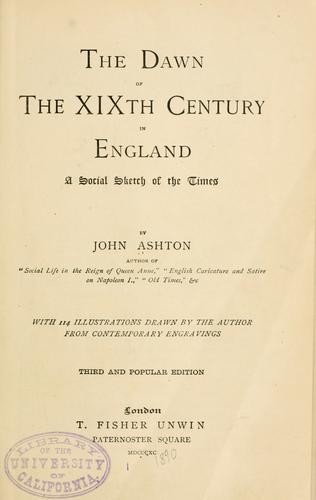
The Dawn of the XIXth Century in England: A social sketch of the timesAshton, John
History
The Dawn of the XIXth Century in England: A social sketch of the times
Ashton, John
England -- Social life and customs -- 19th century
Plans for a new theatre were soon got out, and Mr. Smirke (afterwards
Sir Robert, to whom we owe the beautiful British Museum, and the
General Post Office) was the architect. The first stone was laid, with
much Masonic pomp, on the 31st of December, 1808, by the Prince of
Wales, the Duke of Sussex, and a distinguished circle of guests, being
present. The weather was unpropitious, but immense crowds of people
were present; and it is curious to learn, as showing the defective
police of the time, that “The Horse Guards patrolled the streets, and
several of the Volunteer Corps did duty on the occasion.”
Within two months from the above date, Drury Lane Theatre was totally
destroyed by fire. On the 24th of February, about 11 p.m., it was
discovered, and it did not take long before the whole was in a blaze;
not for want of precautions, for it seems they had adopted the best
accepted preventitives of a great theatrical conflagration known to
modern architects, viz., an iron curtain, and a huge reservoir of
water on the top of the building—the latter being described as “a
mere bucket full to the volume of fire on which it fell, and had no
visible effect in damping it,” which may be comforting for modern
playgoers to remember. Nor was it long in burning; by 5 a.m. “the
flames were completely subdued”—that is, there was nothing left to
burn. Very little was saved, only a bureau and some looking-glasses,
from Mrs. Jordan’s dressing-room, and the “Treasury” books and some
papers. Sheridan took his loss, outwardly, with great _sang froid_,
one anecdote affirming that, on a remark being made to him that it was
a wonder he could bear to witness the destruction of his property, he
replied, “Why! where can a man warm himself better than at his own
fire-side?” However, by his energy, he soon found temporary premises
for his company, and, having obtained a special license from the Lord
Chamberlain, he took the Lyceum and opened it on the 25th of September,
or, within a week of the fire.
[Illustration]
CHAPTER XL.
The O. P. Riots—Causes of—Madame Catalani—Kemble’s refutation of
charges—Opening of the theatre, and commencement of the riots—O.
P. medals, &c.—“The house that Jack built”—A committee of
examination—Their report—A reconciliation dinner—Acceptation of a
compromise—“We are satisfied”—Theatre re-opens—Re-commencement of
riots—The proprietors yield, and the riots end.
WE NOW come to the celebrated O. P. Riots, which find no parallel in
our theatrical history, and which would require at least two thick
volumes to exhaust. Never was there anything so senseless; never could
people have been more persistently foolish; they would listen to no
reason; they denied, or pooh-poohed, every fact.
Public-domain text, read in full here on John Shaqi.
Reviews
Reviews
No reviews yet
Be the first to share your thoughts on this work.
Elsewhere in the archive
Join the Discussion
Join the discussion
Sign in to leave a comment or review.
Sign InorCreate an account