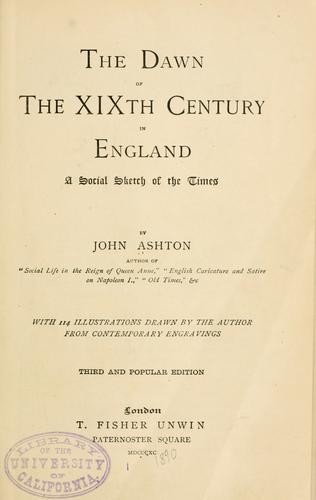
The Dawn of the XIXth Century in England: A social sketch of the timesAshton, John
History
The Dawn of the XIXth Century in England: A social sketch of the times
Ashton, John
England -- Social life and customs -- 19th century
At sixteen, she made her _début_ at Venice, in an opera by Nasolini;
and she afterwards sang at Florence, at La Scala in Milan, at Trieste,
Rome, and Naples. Her fame got her an engagement at Lisbon, where she
married M. Valabrègue, a French officer attached to the Portuguese
Embassy; but she still kept to her name of Catalani—at all events,
on the stage. From Lisbon she went to Madrid, thence to Paris, where
she only sang at concerts; and, finally, in October, 1806, she came to
London, where she speedily became the rage. According to one biographer
(Fétis), she gained immense sums here; but I much doubt his accuracy.
He says: “In a single theatrical season which did not last more than
four months, she gained about 180,000 francs (£7,200), which included
her benefit. Besides that, she gained, in the same time, about 60,000
francs (£2,400) by _soirées_ and private concerts. They gave her as
much as 200 guineas for singing at Drury Lane, or Covent Garden—‘God
save the King,’ and ‘Rule, Britannia,’ and £2,000 sterling were paid
her for a single musical fête.”
[Illustration: CATALANI.]
This, according to the scale paid her at Covent Garden, said by her
opponents to be £75 per night, must be excessive; but the mob had
neither sense, nor reason, in the matter; she was a foreigner, and
native talent was neglected. Her name suggested a subject to the
caricaturist, of which he speedily availed himself.
These were the principal indictments against Kemble (for he, as
manager, had to bear the brunt of the riot) and the proprietors replied
to them categorically—_vide_ _Morning Post_, September 18, 1809:
“It is stated that the old For £25,000, read £1,000.
materials of the Theatre The bricks were of so little
were estimated at £25,000 value, that not one old brick
was used in the building,
and the greater part now
lie buried near Hart Street.
It is stated that instead For 22 read 12 additional
of twelve private boxes, private boxes. In fact, the
they have now thirty-four, Proprietors contend that
being an addition of twenty-two they have no private boxes,
private boxes. as all of them are let annually
to the Public. They
are taken by the higher
classes of society, and, by
that means, the first and
second circles of boxes are
left free for the public at
large. What the Proprietors
gain by them annually,
they lose nightly.
Public-domain text, read in full here on John Shaqi.
Reviews
Reviews
No reviews yet
Be the first to share your thoughts on this work.
Elsewhere in the archive
Join the Discussion
Join the discussion
Sign in to leave a comment or review.
Sign InorCreate an account