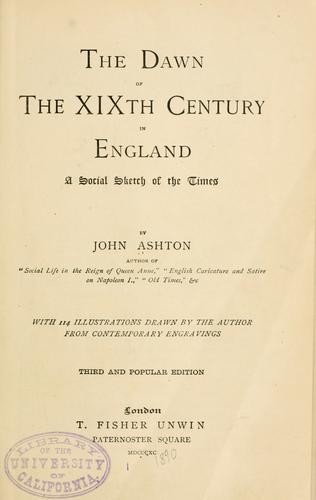
The Dawn of the XIXth Century in England: A social sketch of the timesAshton, John
History
The Dawn of the XIXth Century in England: A social sketch of the times
Ashton, John
England -- Social life and customs -- 19th century
On the 22nd of September Kemble came forward and said, _inter alia_,
that the proprietors, anxious that their conduct should be fully looked
into, were desirous of submitting their books, and their accounts, to a
committee of gentlemen of unimpeachable integrity and honour, by whose
decision they would abide. Meanwhile the theatre would be closed, and
Madame Catalani, cancelling her engagement, went to Ireland.
“THE DEPARTURE FOR IRELAND.
“When _Grimalkin_[61] the Spy, took a peep at the house,
And saw such confusion and strife,
He stole to the Green-room as soft as a Mouse,
And thus he address’d his dear wife:
‘MON DIEU! don’t sit purring, as if all was right,
Our measure of meanness is full,
We cannot stay here to be bark’d at all night,
I’d rather be toss’d by a _Bull._’”
The committee of gentlemen (of whom the well-known John Julius
Angerstein was one), published their report, and balance sheet, which
was publicly advertised on the 4th of October, and they agreed that
the profit to the shareholders on the capital, employed during the six
years, was 6⅜ per cent. per annum, and that during that time they had
paid £307,912. This, of course, would not satisfy the mob, and on the
re-opening of the theatre on the 4th of October there was the same
riot with its concomitant din of cat calls, rattles, horns, trumpets,
bells, &c. For a few days the riot was not so bad, although it still
continued; but, on the 9th of October, it broke out again, and the
proprietors were compelled to take proceedings at Bow Street against
some of the worst offenders. This had the effect, for a time, of
stopping the horns, rattles, bells, bugles, &c., but the rioters only
exchanged one noise for another, for now they imitated all the savage
howlings of wild beasts, and it seemed as if Pidcock’s Menagerie had
been turned into the theatre.
This soon got too tame, and on the 20th of October they began
fighting among themselves, and stripping the baize off the seats.
On the 24th, the proprietors issued a very proper address to the
people, showing that they were not getting exorbitant profits, and,
consequently, the prices were not too high; but it had no effect until
the Grand Jury found true bills against some of the rioters, when
there was a lull for a time, which might have been permanent, had not
Brandon, the boxkeeper, charged a Mr. Clifford with having created a
commotion in the pit. After examination, however, at Bow Street, he
was released—and then the mob had another grievance. Brandon must be
dismissed; nor only so—on the 5th of November a mob went to Bloomsbury
Square, and broke the windows in Kemble’s house, after which, there was
another lull; then on the 25th the turbulent spirits broke out again,
because it was the fiftieth night, or _jubilee_, of the riots. A few of
them were charged at Bow Street, but that did not stop the riot till
nearly the middle of December, when there was another lull in the storm.
Public-domain text, read in full here on John Shaqi.
Reviews
Reviews
No reviews yet
Be the first to share your thoughts on this work.
Elsewhere in the archive
Join the Discussion
Join the discussion
Sign in to leave a comment or review.
Sign InorCreate an account