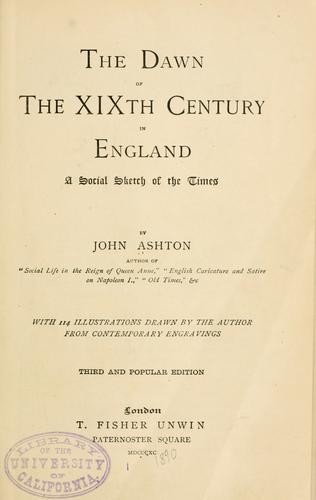
The Dawn of the XIXth Century in England: A social sketch of the timesAshton, John
History
The Dawn of the XIXth Century in England: A social sketch of the times
Ashton, John
England -- Social life and customs -- 19th century
Both sides were getting weary of the strife; and, on the 14th of
December, a dinner was held at the Crown and Anchor Tavern, Covent
Garden, at which Kemble met the Opposition, and a compromise was
entered into, and agreed upon, that the boxes were to remain the
same price—7s.—the pit was to revert to the old price of 3s. 6d.;
and the galleries to remain as they were; the private boxes, at the
end of the season, were to be again restored, and appropriated to
the accommodation of the public. The rioters wanted Brandon to be
discharged, and at night, when he had to appear before his sweet
masters, they saluted him with volleys of oranges, and walking-sticks;
and, the next night, it was announced that Brandon had been sacrificed
to public opinion, and had been dismissed.[62] One or two more
apologies for small _lâches_, and King Mob produced a placard, “WE ARE
SATISFIED.”
But they were not; they wanted the boxes reduced to 6s.; and, having so
long had license, the ferment was not subdued at once. Take the 19th
of December, for instance; Kemble was hissed, on his appearance on the
stage, and when he spoke the lines—
“The times are out of joint—Oh, cursed spite!
That ever I was born to _set them right_!”—
there was an universal shout of derision.
For the remainder of that season there was peace; but, when the new
season opened, on September 10, 1810, with “The Beggar’s Opera,” and
“Raising the Wind,” it was found that part of the treaty had not been
carried out; as, although the centre portion of the first tier, had
been converted into public boxes; yet, on either side, were still the
objectionable private boxes, which, last year, had so excited the
prudishly virtuous indignation of a howling mob. “No foreign sofas! No
Italian private boxes.” In vain did Kemble point out that, since the
conclusion of the treaty, an Act of Parliament had been passed for the
rebuilding of Drury Lane Theatre, which allowed the proprietors to have
as many private boxes as they might find convenient; and, consequently,
would place Covent Garden at a decided disadvantage; therefore, his
proprietary had hoped the public would condone the fact of their still
retaining a few private boxes. Oh, no! The O. P. dance and the O. P.
song, were immediately revived in all their glory, and the remainder
of the evening was spent in the old manner, minus the accompaniment of
horns, rattles, or placards; but a quart bottle was thrown from the
gallery into the pit, and the management offered a reward of fifty
guineas for the conviction of the offender.
Next night there were two placards exposed: “O. P. We have been
imposed on!” “O. P. The Treaty is broken; open War!” The night after,
the row got worse. On the 14th of September it was as bad as last
year—watchmen’s rattles were freely used, and mewing, barking,
groaning, braying, and whistling, made a hideous chorus. The O. P.
dance was changed to the “Contract” dance, but still was danced to the
tune of the O. P. hornpipe.
Public-domain text, read in full here on John Shaqi.
Reviews
Reviews
No reviews yet
Be the first to share your thoughts on this work.
Elsewhere in the archive
Join the Discussion
Join the discussion
Sign in to leave a comment or review.
Sign InorCreate an account