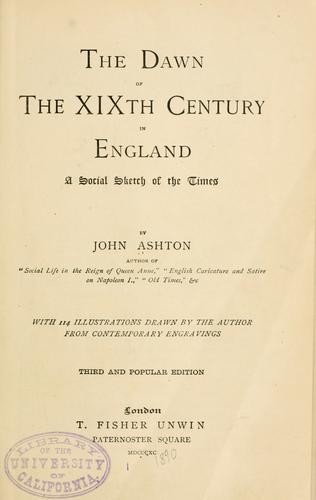
The Dawn of the XIXth Century in England: A social sketch of the timesAshton, John
History
The Dawn of the XIXth Century in England: A social sketch of the times
Ashton, John
England -- Social life and customs -- 19th century
The proprietors, after their bitter experience of the previous year,
felt that, however right they might be, they could not contend against
the _force majeure_ of the mob; and, on the 16th of September, they
pledged themselves “that next season (when they will again have
returned into their possession) the eight annual boxes shall be given
up, and let to the public, at large, as nightly boxes.” It was no use;
that night the row was as bad as ever; and, after that performance, the
theatre was closed to make the alterations in the boxes, which were
thrown open to the public. The theatre was re-opened on the 24th of
September, and the performances passed off without interruption. And so
ended the eventful O. P. Riots.
[Illustration]
[Illustration]
CHAPTER XLI.
“The Pic-nic Club”—Its supporters—Its entertainment—Its short
life—Automata and wool pictures—Almack’s—Pidcock’s Menagerie—“The
Invisible Girl”—Vauxhall—Sir Roger de Coverley—Price of admission,
&c.—Ranelagh Gardens.
THE THEATRE, although the main source of amusement, was not the only
one. There were masquerades at the Pantheon, and a private theatrical
club, called the “Pic-nic Club,” of which a Captain Caulfield was the
manager. Lady Buckinghamshire—foremost in this, as in gaming—was one
of its chief supporters; and it took its name from every one drawing
lots, as to what should be his, or her, share of the entertainment.
This club consisted of the leaders of fashion—the Prince of Wales,
Lords Cholmondeley, Valletort, Carlisle, Spooner, Kirkcudbright, and
Derby; and, of course, “old Q,” the Duke of Queensberry. Sir Lumley
Skeffington, also, was an ornament to the society; whilst the lady
members besides Lady Albina Buckinghamshire, numbered in their ranks,
Lady Salisbury, Lady Jersey, and Mrs. Fitzherbert. It was _crême de la
crême_, and I find them chronicled in the _Morning Herald_ of March
16, 1802, thus: “The _Pic-nic_ Club met last night for the first time,
in the Tottenham Street Rooms.[63] The Entertainment commenced with a
Prologue by Colonel Greville, which was followed by a French Proverb.
An Act of the _Bedlamites_, a piece translated from the French, for
the occasion, was then performed. A French Proverb, and an Epilogue,
succeeded; and the whole succeeded with a _Pic-nic_ Supper, provided
from a tavern.[64] The company was not numerous, though 300 cards
of invitation were issued. Madame Parisot,[65] disapproving of the
_dilettanti_ project, refused to take any part in the performance. It
being apprehended that the public peace might be disturbed by this
irregular assemblage, the Bow Street officers held themselves in
readiness to act, during the whole of the evening, but happily there
was no occasion for their services.”
The society afterwards moved to the Argyle Rooms, then most highly
proper, and fashionable. There were several caricatures of this society
from Gillray’s pencil, one of which (the next illustration) I reproduce.
Public-domain text, read in full here on John Shaqi.
Reviews
Reviews
No reviews yet
Be the first to share your thoughts on this work.
Elsewhere in the archive
Join the Discussion
Join the discussion
Sign in to leave a comment or review.
Sign InorCreate an account