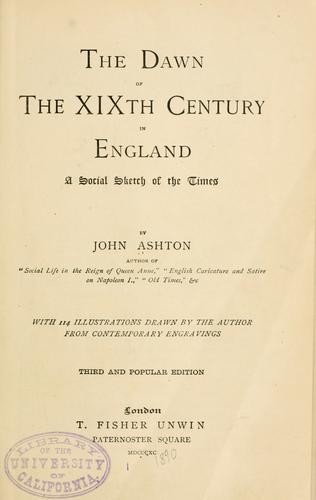
The Dawn of the XIXth Century in England: A social sketch of the timesAshton, John
History
The Dawn of the XIXth Century in England: A social sketch of the times
Ashton, John
England -- Social life and customs -- 19th century
There was a split in the musical camp, and a branch of the parent
society seceded, and established themselves at the Opera House, in
the Haymarket, under the title of “The Concert of Ancient Music,” or
“King’s Concerts.” They afterwards moved to the Hanover Square Rooms.
The concerts commenced in February, and continued till the end of May.
Six directors, chosen from the nobility, selected, in turn, the pieces
for each concert—at which all modern music was utterly excluded, and
nothing could be played unless twenty-five years old. So strictly
was this carried out, that if the director for the night introduced
anything more modern, he was (and it was done more than once) fined in
a very considerable sum. There were also popular concerts held at the
Hanover Square rooms, during the season, to which the admission was
generally half a guinea.
And yet, with all this reverence for old music, it was found impossible
to make a success of a “Commemoration of Dr. Arne,” which took place
at Ranelagh on June 10, 1802; the expenses being £100, and the actual
receipts for the night only £26! Well may the newspaper editor end the
paragraph with “Poor Thomas Arne!”
In contradistinction to this, a Competition of Pipers, which was
annual, seems to have been a great success. The Highland Society
of London gave the prizes, three in number: 1st, a handsome set of
pipes with a silver plate, and forty merks Scots; 2nd and 3rd, thirty
merks, and it was decided at the Theatre Royal, Edinburgh, before an
enthusiastic audience.
The principal dance of this period was the country dance; but the valse
had already been introduced, and rapidly came into favour, although it
was held to be fast, and rather indecent, and was danced in a somewhat
different style to what it is nowadays.
[Illustration: WALTZER AU MOUCHOIR—1800.]
[Illustration: LA VALSE—1810.]
[Illustration]
CHAPTER XLIII.
Painting—“The Royal Academy of Art”—The principal private
Picture Galleries—Benjamin West—James Barry—Fuseli—Opie—Minor
artists—Turner—Sir Thomas Laurence—Morland—Sale of his
pictures—Sculptors—Engravers—Boydell—“The Exhibition of
Paintings in Water Colours”—Its members-”The Associated Artists
in Water Colours”—Literature—List of literary persons of the
decade—Five-volume novels—Decyphering papyri—Major Ouseley’s
Oriental Library—The Pope and the Lord’s Prayer—The Alfred Club.
PAINTING was not at its highest at this time, and yet there were many
buyers, even for the pictures then painted. The Royal Academy of Art
(founded in 1765, when it received its Charter, on the 26th of January,
as the Incorporated Society of British Artists, a name afterwards
changed in 1768) was then located at Somerset House, where life classes
were held, and instruction given, as shown in the illustration on the
next page.
Public-domain text, read in full here on John Shaqi.
Reviews
Reviews
No reviews yet
Be the first to share your thoughts on this work.
Elsewhere in the archive
Join the Discussion
Join the discussion
Sign in to leave a comment or review.
Sign InorCreate an account