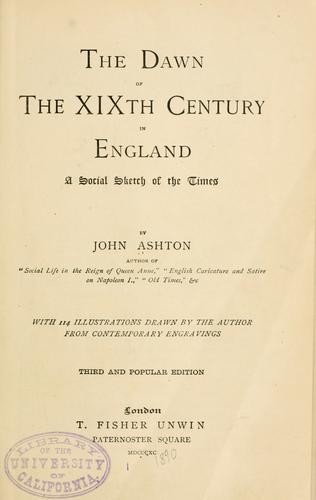
The Dawn of the XIXth Century in England: A social sketch of the timesAshton, John
History
The Dawn of the XIXth Century in England: A social sketch of the times
Ashton, John
England -- Social life and customs -- 19th century
But, as yet, there was no National Gallery of Paintings, that was
reserved till a latter period, when Government bought the collection
of John Julius Angerstein, Esq., in 1824. This formed the nucleus of
our magnificent collection. His gallery, at his house in Pall Mall, had
long held high rank among the private picture collectors, he having two
Murillos, for which he paid 3,500 guineas. The Duke of Bridgewater’s,
the Marquis of Lansdowne’s, the two, or rather three, Hopes’, Lord
Radstock’s, the Duke of Northumberland’s, the Duke of Devonshire’s, and
the Miniatures at Strawberry Hill, were all magnificent collections;
whilst Mr. Charles Townley, at his residence in Park Lane, had the
finest collection of antique statues and busts, &c., in the world.
These are now in the British Museum.
[Illustration: DRAWING FROM LIFE AT THE ROYAL ACADEMY—1808.]
The principal painters of this decade, although numerous, do not
represent a school likely to be perpetuated, although, as we read them,
they are well known; many are respectable, two or three are famous.
First must come Benjamin West, President of the Royal Academy, who then
lived in Newman Street: and, indeed, if we look at the addresses of
these old painters, we find them very humble compared with the palatial
habitations of some of our modern painters. As a _Master_, West will
never live, he was a respectable painter, but even in his own time, was
not over belauded.
There was James Barry, who was once professor of painting to the
Academy, but was deposed, _en plein cours_, because he could, or would,
not confine his lectures to their proper subjects, besides being coarse
and libellous. This made him hypochondriac, and he, besides, became
poor—a position somewhat alleviated by an annuity which was subscribed
for him. He died in 1806. His dwelling was in Castle Street, Oxford
Street.
Henry Fuseli lived in Queen Anne Street, East. His pictures were
noted for the extravagance of their conception, and their anatomy; he
delighted in painting the horrible, and supernatural, and was, perhaps,
seen at his best in his Milton Gallery, which was opened in 1798, and
closed July 19, 1800.
John Opie made a name, which still lives among collectors, but he
never will rank as an Art Master. He owed much of his celebrity to Dr.
Wolcott (Peter Pindar), who, an artist himself, tried to bring his
_protégé_ into notoriety. He lived in Berner’s Street, Oxford Street,
and died in 1807.
De Loutherbourg and his imitator, Sir Francis Bourgeois, are hardly
worthy of a notice. The latter, certainly, left a collection of
pictures to Dulwich Gallery, with £10,000 to keep them in preservation;
£2,000 for the repair of the gallery, and a complimentary bequest of
£1,000 to the Masters and Fellows of Dulwich College.
Public-domain text, read in full here on John Shaqi.
Reviews
Reviews
No reviews yet
Be the first to share your thoughts on this work.
Elsewhere in the archive
Join the Discussion
Join the discussion
Sign in to leave a comment or review.
Sign InorCreate an account