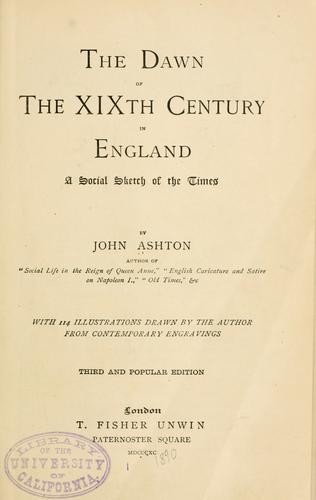
The Dawn of the XIXth Century in England: A social sketch of the timesAshton, John
History
The Dawn of the XIXth Century in England: A social sketch of the times
Ashton, John
England -- Social life and customs -- 19th century
The genius of the age was, undoubtedly, Joseph Mallord William Turner,
who ranks as one of our greatest landscape painters. Like all other
artists, he had his periods of excellence; but, when at his best, he
was unapproachable. Thoroughly appreciated in this decade, he died not
so long ago, December 19, 1851.
From Turner to James Northcote is a long step, but they were on the
same footing as Royal Academicians. He tried to be, as some of our
modern R.A.’s do, an universal genius; but the verdict of posterity has
not endorsed his pretensions. He lived then in Argyll Street, and did
not die until July 13, 1831.
Another Academician, Thomas Stothard, deserves notice, and will be most
remembered for his “Canterbury Pilgrims;” but his style was mannered,
and did he paint now, he, probably, would not get a living.
Sir Thomas Lawrence did not then occupy the position he afterwards
filled, of President of the Royal Academy; but he had the rare honour
of being made a “Supplemental Associate;” a rank conferred, because
his youth would not entitle him to ask for the ordinary Associateship.
He was then living modestly in Greek Street, Soho, and did not charge
much for his pictures. In 1802 he only got thirty guineas for a
three-quarter size, and sixty guineas for a half-length portrait. In
1806, he obtained fifty guineas for three-quarter, and whole length,
two hundred guineas. 1808 saw his prices still go higher, similar
sizes eighty and three hundred guineas; and in 1810, he charged one
hundred guineas for a head, and four hundred guineas for a full length.
Handsome prices, yet poor pay compared to what our pet artists now get.
Robert Smirke, R.A., then living in Charlotte Street, was a painter
of English _genre_ pictures, and was very fond of painting scenes
from Don Quixote. Sir David Wilkie, however, painted _genre_ subjects
inimitably, and stood pre-eminent in this branch of art, at the period
of which I write.
Sir William Beechey was a respectable portrait painter, and filled that
office to Her Majesty Queen Charlotte, but he was not a Sir Joshua.
He then lived at Great George Street, Hanover Square; but he died at
Hampstead, in 1839, at a good old age of over eighty. John Hoppner,
R.A., was another portrait painter of the time, as was also Sir Martin
Archer Shee, President R.A., then living in Cavendish Square.
Westall, as being an Academician, deserves a passing notice, and
Reinagle, too; but neither have made a name that will live. One minor
painter deserves to be mentioned, Henry Bone, the enamel painter, whose
collection of his own works (valued at £10,000) was offered to the
nation for £4,000, refused, and sold under the hammer for £2,000. John
Singleton Copley was still alive, as was also Angelica Kauffman, nor
must the name of Sir George Howland Beaumont be omitted; but he was
more of an amateur than professional artist.
[Illustration: CONNOISSEURS EXAMINING A COLLECTION OF GEORGE MORLAND.]
Public-domain text, read in full here on John Shaqi.
Reviews
Reviews
No reviews yet
Be the first to share your thoughts on this work.
Elsewhere in the archive
Join the Discussion
Join the discussion
Sign in to leave a comment or review.
Sign InorCreate an account