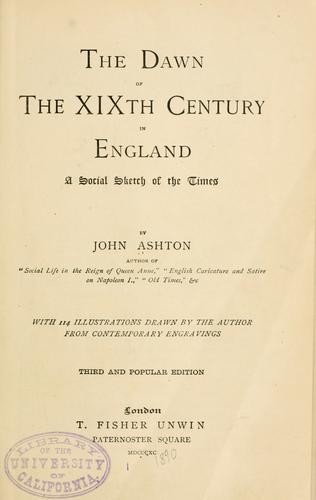
The Dawn of the XIXth Century in England: A social sketch of the timesAshton, John
History
The Dawn of the XIXth Century in England: A social sketch of the times
Ashton, John
England -- Social life and customs -- 19th century
OF THE London Daily papers that were then existing, but two are now
alive—the _Morning Post_ (the _Doyen_ of the daily press) and the
_Times_. They were heavily taxed, in 1800, with a 3d. stamp per copy.
In July, 1804, this was made 3½d.; pamphlets, half-sheet, ½d.; whole
sheet, 1d.; an Almanac had to have a shilling stamp; and a perpetual
Calendar, one of 10s. And this oppressive stamp, with a comparatively
limited circulation, meant death to a newspaper. In 1809, the _Morning
Post_, and other papers, boldly went in for a halfpenny rise, and gave
its reasons—May 20: “Since the settlement with Government took place,
which fixed the price at sixpence, every article necessary for the
composition of a Newspaper, has increased in price to an unprecedented
extent. Paper has risen upwards of fifty per cent.; Types upwards of
eighty per cent.; Printing Ink thirty-five per cent.; Journeymen’s
wages ten per cent., and everything else in the same proportion. It
is therefore unnecessary for us to observe, that the advance of One
Halfpenny per Paper will go but a short way towards placing the
Proprietors in the same situation, in respect to profits allowed, in
which they were left by the settlement of 1797; and, under all these
considerations, the Public, we trust, will not deem us unreasonable
in availing ourselves of the parliamentary provision that has just
been made in favour of all Newspapers. The Bill will receive the Royal
Assent this day, and on Monday, the Price of the _MORNING POST_, _in
common with that of other Newspapers_, will be Sixpence Halfpenny.”
Then, as now, the backbone of a Newspaper was its advertisements, and
then also, did each Newspaper laud itself as being the best advertising
medium, owing to its superior circulation. We, who are accustomed
to see huge posters setting forth sworn affidavits that the daily
circulation of some London newspapers amounts to some quarter of a
million if not more, will feel some surprise when we learn that the
_Morning Post_, of June 10, 1800, the then leading paper, published
a sworn return (and exulted over their number and success) of 10,807
newspapers printed in the week June 2-7, or a daily average of 1,800
copies.
The _World_, at one time a rival, had published its circulation when
it reached 1,500 daily, and thus laid claim to be considered a good
advertising medium; and this was when newspapers were selling at 3d.
each. In 1800 they were 6d. each, and the extra tax had diminished
the circulation of the _Morning Post_ during the previous summer by
one-third, which fall they claim to have recovered, and to have raised
their circulation in five years from 400 to 1,800 daily. In June, 1796,
the _Times_ published its number; and again in 1798, when it confessed
to a fall of 1,400 in its daily sale.
In 1806 there was a very pretty little war as to the circulation of
rival newspapers.
Public-domain text, read in full here on John Shaqi.
Reviews
Reviews
No reviews yet
Be the first to share your thoughts on this work.
Elsewhere in the archive
Join the Discussion
Join the discussion
Sign in to leave a comment or review.
Sign InorCreate an account