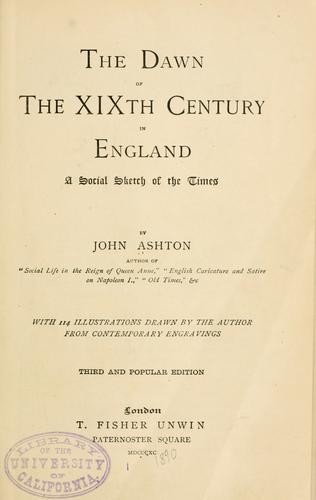
The Dawn of the XIXth Century in England: A social sketch of the timesAshton, John
History
The Dawn of the XIXth Century in England: A social sketch of the times
Ashton, John
England -- Social life and customs -- 19th century
Take what it was like in 1802: “Persons who are desirous of seeing the
Museum, must enter their name and address, and the time at which they
wish to see it, in a book kept by the porter, and, upon calling again
on a future day, they will be supplied with printed tickets, free of
expense, as all fees are positively prohibited. The tickets only serve
for the particular day and hour specified; and, if not called for the
day before, are forfeited.
“The Museum is kept open every day in the week, except Saturday, and
the weeks which follow Christmas day, Easter, and Whitsunday. The hours
are from nine till three, except on Monday and Friday, during the
months of May, June, July, and August, when the hours are only from
four till eight in the afternoon.
“The spectators are allowed three hours for viewing the whole—that is,
an hour for each of the three departments. One hour for the Manuscripts
and Medals; one for the natural and artificial productions, and one
for the printed books. Catalogues are deposited in each room, but no
book must be taken down except by the officer attending, who will also
restore it to its place. Children are not admitted.
“Literary characters, or any person who wishes to make use of the
Museum for purposes of study and reference, may obtain permission,
by applying to the trustees, or the standing committee. A room is
appointed for their accommodation, in which, during the regular hours,
they may have the use of any manuscript or printed book, subject to
certain regulations.”
On the 8th of June, 1804, the Trustees somewhat modified the
arrangements, and instead of visitors having to call twice about
their tickets, before their visit, they might be admitted the day
of application (Monday, Wednesday, or Friday only) subject to the
following rule:
“Five Companies, of not more than 15 persons each, may be admitted in
the course of the day; namely, one at each of the hours of 10, 11, 12,
1, and 2. At each of these hours the directing officer in waiting shall
examine the entries in the book; and if none of the persons inscribed
be exceptionable, he shall consign them to the attendant, whose turn it
will be to conduct the companies through the House.
“Should more than fifteen persons inscribe their names, for a given
hour, the supernumeraries will be desired to wait, or return at the
next hour, when they will be admitted preferably to other applicants.”
The Museum Gardens were a great attraction, and were much visited. So
much, indeed, were they thought of, that, in an advertisement of a
house to let, it is stated, as a great recommendation that it commands
“a view of the Museum Gardens, and a part of Hampstead Heath.”
Public-domain text, read in full here on John Shaqi.
Reviews
Reviews
No reviews yet
Be the first to share your thoughts on this work.
Elsewhere in the archive
Join the Discussion
Join the discussion
Sign in to leave a comment or review.
Sign InorCreate an account