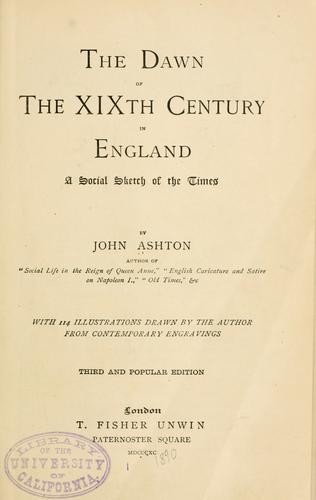
The Dawn of the XIXth Century in England: A social sketch of the timesAshton, John
History
The Dawn of the XIXth Century in England: A social sketch of the times
Ashton, John
England -- Social life and customs -- 19th century
This latter part—the cure of the insane by means of electricity—has
not been verified by practice. Their treatment was very inefficient,
although, even then, whips and chains were disappearing—especially in
the public madhouses, which were at that time Bethlehem, and St. Luke’s
Hospitals. Bethlehem Hospital was then situated in Moorfields, and
the major part of it had been built in 1675. Over the entrance gates
were two sculptured representations of Raving and Melancholy madness,
by Cibber; these are now in the hall of the present hospital. Patients
remained until they were cured, or for twelve months if not cured.
In the latter case if it was thought that a further sojourn might be
of use, they were re-admitted, and they also were permanently kept,
were they hopelessly incurable, and dangerous to society. There were
then about 260 patients who might be visited by their friends every
Monday and Wednesday, from 10 to 12 a.m. Visitors were only admitted
by an order from a governor—a vast improvement on the old plan, when
a visitor could always obtain admission by payment of a small fee. In
fact, in Queen Anne’s reign, and later, it formed, with the lions at
the Tower, and the wax figures at Westminster Abbey, one of the chief
sights in London, thus causing a scandal to the institution, and,
without doubt, injuring the patients.
[Illustration: WOMEN’S WARD, ST. LUKE’S—1808.]
St. Luke’s Hospital for the insane was in Old Street, City Road,
and was built because Bethlehem was inadequate to the relief of _all
indigent lunatics_; and their treatment was fairly rational, even those
who were obliged to wear straight jackets having their meals together,
so as to afford some little break in the monotony of their miserable
lives. Each patient had a separate sleeping apartment, and there were
two large gardens, one for men, the other for women, where pleasant
recreation could be taken in fine weather.
The other medical hospitals were—Bartholomew’s, St. Thomas’s, Guy’s,
St. George’s, the London, Middlesex, the Westminster Infirmary, and the
Lock Hospital, in Grosvenor Place. The majority of these had regular
medical schools, as now, but there were, also, many private lecturers
and demonstrators of anatomy, as also professors of natural and
experimental philosophy, and chemistry.
[Illustration]
[Illustration]
CHAPTER XLVI.
The Royal Society and the Royal Institution—Scientific
men of the time—Society of Arts—Other learned
Societies—Ballooning—Steam—Steamboats—Locomotives—Fourdrinier and
the paper-making machine—Coals—Their price—Committee of the House
of Commons on coal—Price of coals.
THE ROYAL Institution had just been founded (incorporated 13th January,
1800), and the Gresham lectures were held. The Royal Institution was
patronized by its big elder brother, the Royal Society, for in the
minutes of the proceedings of the latter, on the 15th of April, 1802,
is the following:
Public-domain text, read in full here on John Shaqi.
Reviews
Reviews
No reviews yet
Be the first to share your thoughts on this work.
Elsewhere in the archive
Join the Discussion
Join the discussion
Sign in to leave a comment or review.
Sign InorCreate an account