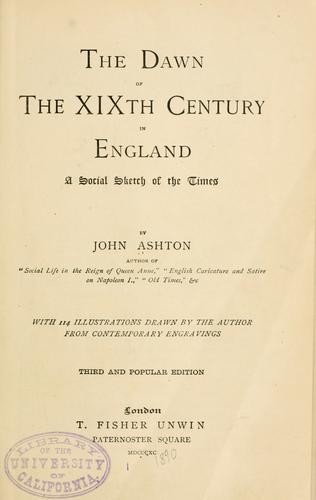
The Dawn of the XIXth Century in England: A social sketch of the timesAshton, John
History
The Dawn of the XIXth Century in England: A social sketch of the times
Ashton, John
England -- Social life and customs -- 19th century
“Resolved, that ... the Royal Society be requested to direct their
Secretaries to communicate from time to time to the Editor of the
Journals of the Royal Institution, such information respecting the
Papers read at the Meetings of the Society, as it may be thought proper
to allow to be published in these Journals.”
In the first ten years of this century, no great scientific discoveries
were made; the most prominent being the researches of that marvellous
scientist and Egyptologist, Dr. Thomas Young,[69] in connection with
physical optics, which led to his theory of undulatory light.[70] Yet
there were good men coming forward, the pioneers of this present age,
to whose labours we are much indebted; and any decade might be proud
of such names as Faraday, Banks, Rennie, Dr. Wollaston, Count Rumford,
Humphrey Davy, and Henry Cavendish, whose discovery of the gaseous
composition of water laid the foundation of the modern school of
chemistry.
The Society of Arts, too, was doing good work, and the Society of
Antiquaries, and the Linnæan Society, were also in existence; but the
Horticultural, and Geological Societies, alone, were born during this
ten years.
Ballooning was in the same position as now, _i.e._, bags of gas could,
as is only natural, rise in the air, and be carried whither the wind
listed; and, especially in the year 1802, ærostatics formed one of the
chief topics of conversation, as Garnerin and Barrett were causing
excitement by their ærial flights.
Man had enslaved steam, but had hardly begun to utilize it, and knew
but very little of the capabilities of its energetic servant. Then it
was but a poor hard-working drudge, who could but turn a wheel, or
pump water. Certainly a steamboat had been tried on the Thames, and
Fulton’s steamboat _Clermont_ was tried on the Seine in 1803, at New
York in 1806, and ran on the Hudson in 1807; but the locomotive was
being hatched. The use of iron rails to ease the draft was well known,
and several patents were granted for different patterns of rail, but
they were mainly used in mines, to save horse power. Under the date
of 24th March, 1802, is a “Specification of the Patents granted to
Richard Trevithick and Andrew Vivian, of the Parish of Camborne, in the
County of Cornwall. Engineers and Miners, for Methods for improving
the construction of Steam Engines, and the Application thereof for
driving Carriages, and for other purposes.” Here, then, we have the
germ of the locomotive, which has been one of the most powerful agents
of civilization the world ever saw. But it was not till 1811 that the
locomotive was used, and then only on a railway connected with a
colliery.
Public-domain text, read in full here on John Shaqi.
Reviews
Reviews
No reviews yet
Be the first to share your thoughts on this work.
Elsewhere in the archive
Join the Discussion
Join the discussion
Sign in to leave a comment or review.
Sign InorCreate an account