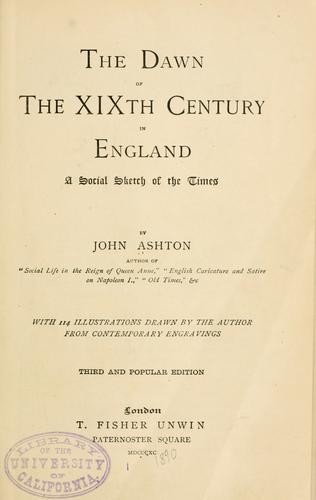
The Dawn of the XIXth Century in England: A social sketch of the timesAshton, John
History
The Dawn of the XIXth Century in England: A social sketch of the times
Ashton, John
England -- Social life and customs -- 19th century
But not only were they unattainable, but many of the coal-fields from
which we now draw our supplies were absolutely unknown. Here is an
instance—_Morning Post_, July 25, 1805: “A very fine _stratum_ of
coal, 15 feet deep, has been lately discovered on the Earl of Moira’s
estate at Donnington, and by which the Leicestershire Canal Shares have
been doubled in their value.”
[Illustration: A COLLIERY—1802.]
In looking at the following list of prices of coals, it must be borne
in mind that these are the market prices for coals _ex ship_; and it
was reckoned that 12s. per ton was a fair price to allow for metage,
carriage, and profit. Add this, and remember that a sovereign at
the commencement of the century had the purchasing power of, and,
consequently, worth, about 30s.; it will then be seen that coals were
excessively dear—such as would now practically extinguish every
manufacture.
Even in 1800, when coals were only about 48s. or 48s. 6d., the price
was considered so excessive, that a Committee of the House of Commons
sat upon the subject, and issued a report, imputing it to the following
causes:
“1. The agreement among the Coal Owners in the North, called ‘The
Limitation of Vends,’ by which each colliery on the Tyne is limited,
so as not to exceed a certain quantity in each year. Those Coal Owners
who are found to have shipped more than their stipulated quantities,
being bound to make a certain allowance at the end of each year,
to those who have shipped less, and to conform to certain other
regulations adopted by the Coal Owners on the river Wear.
“2. The detention of the ships at Newcastle, waiting for the best
coals, sometimes a month or six weeks.
“3. The want of a market in London which would admit of a competition,
perfectly free, in the purchase of coals.
“4. The circumstance of the coal-buyer being, in many instances,
owners both of ship and cargo; which (as appears by the evidence)
leads to considerable abuse.
“5. The want of a sufficient number of Meters, and of craft, for
unloading the ships on their arrival in the river, and the occasional
delays in procuring ballast on their return voyage.
“6. The practice of mixing the best coals with those of an inferior
quality, and selling the whole so mixed as of the best kind; and
“7. To frauds in the measurement, carriage, and delivery of coals.”
That there were great profits made by coals, there can be no doubt.
Mr. Walter, the proprietor of the _Times_, had been a coal-factor, and
had failed in business, before he started his newspaper—in which, in
its early days, he keenly scanned the state of the Coal Market for the
benefit of the public.
Public-domain text, read in full here on John Shaqi.
Reviews
Reviews
No reviews yet
Be the first to share your thoughts on this work.
Elsewhere in the archive
Join the Discussion
Join the discussion
Sign in to leave a comment or review.
Sign InorCreate an account