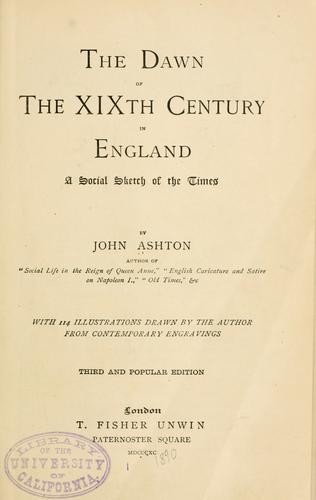
The Dawn of the XIXth Century in England: A social sketch of the timesAshton, John
History
The Dawn of the XIXth Century in England: A social sketch of the times
Ashton, John
England -- Social life and customs -- 19th century
It was not a mechanical age, or rather, applied mechanics was as
a young child, and babbled sillily. The only thing I regret, in
writing this book, is the time I have wasted in looking over Patent
Specifications, to find something worthy to illustrate the mechanical
genius of the time. The most useful invention I have found, is
the paper-making machine. This was originally the conception of a
Frenchman, Louis Robert, who sold his invention to Didot, the great
printer, who, bringing it to England, got Fourdrinier to join with him
in perfecting it. It did not, Minerva-like, spring ready armed from its
parent’s brain; but was the subject of several patents; but the one
which approaches nearest to, and is identical in all essential points
with, the present paper-making machine, is his “Specification, enrolled
pursuant to Act of Parliament of the 47th of George the Third, of the
Invention of Henry Fourdrinier and Sealy Fourdrinier, of Sherborne
Lane, London, and John Gamble, of Saint Neots, in the County of
Huntingdon, Paper Manufacturers; for making Paper by means of Machines,
for which several Letters Patent have been obtained at different
periods. Term extended to 15 years from 14th August, 1807.” This
extension had been obtained by means of an Act of Parliament passed the
previous session, and the machine was capable of making the endless web
of paper now in vogue.
The primitive state of our manufactures at this date may be, perhaps,
best understood by a typical illustration or two, taken by Pyne, a most
conscientious draughtsman, who drew all his studies from nature. The
first, on the next page, is an Iron Foundry, casting shot.
Coals were very dear, and that was owing to two things. First, that
only the Sunderland district coals were used in London, because
they only could, in any quantity, be shipped to London; the vast
Staffordshire, and other inland basins, being out of the question,
owing to lack of carriage, except where a canal was handy; and the
other reason for their high price was that there being no steam
vessels, a contrary wind would keep the coal-ships out of port, and,
consequently, denude the market.
[Illustration: AN IRON FOUNDRY—1802.]
The inland coals were cheap enough in their own localities—_vide_ the
_Morning Post_, August 6, 1800: “At Oldham, in Lancashire, the best
coals are only 6s. 9d. equal to a London chaldron.[71] At Barnsley, in
Yorkshire, the best coals are sold at the pit’s mouth for only 1½d. per
cwt. Surely, permission ought to be granted for coals to be brought to
London, if they can be conveyed by water. This might be done, as the
canals from Lancashire are now cut so as a barge with twenty-five tons
of coals would arrive in London in fourteen days. They cost at the pit
only 8s. 4d. per ton.”
Public-domain text, read in full here on John Shaqi.
Reviews
Reviews
No reviews yet
Be the first to share your thoughts on this work.
Elsewhere in the archive
Join the Discussion
Join the discussion
Sign in to leave a comment or review.
Sign InorCreate an account