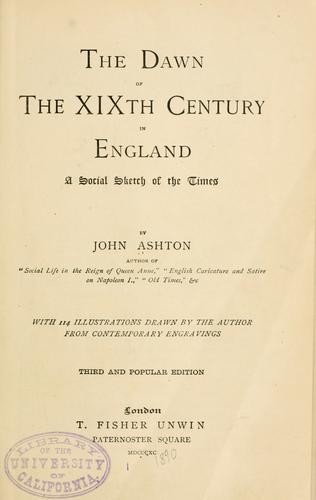
The Dawn of the XIXth Century in England: A social sketch of the timesAshton, John
History
The Dawn of the XIXth Century in England: A social sketch of the times
Ashton, John
England -- Social life and customs -- 19th century
IT WAS the fashion then, as it is now, to portray a sailor, as a
harum-scarum, jovial, rollicking, care-for-nought; and doubtless,
in the main, he was, at that time, as unlike as possible to the
blue-riband, savings-bank Jack that he very frequently is now. Prize
money was pretty plentiful; such things as a temperance captain and
ship, were unknown; and the constant active service in which they were
engaged, with its concomitant insecurity to life and limb, must have
made them somewhat reckless, and inclined to enjoy life, after their
fashion, whilst they still possessed that life. Rowlandson—May 30,
1802—drew two of them in a caricature, called “The Sailor’s Journal.”
They are dividing a bowl of punch, one is smoking, the other gives
his mate some extracts from his Journal: “Entered the port of London.
Steered to Nan’s lodgings, and unshipped my Cargo; Nan admired the
shiners—so did the landlord—gave ‘em a handful apiece; emptied a
bottle of the right sort with the landlord to the health of his honour
Lord Nelson. All three set sail for the play; got a berth in a cabin on
the larboard side—wanted to smoke a pipe, but the boatswain wouldn’t
let me; remember to rig out Nan like the fine folks in the cabin right
ahead. Saw Tom Junk aloft in the corner of the upper deck—hailed him;
the signal returned. Some of the land-lubbers in the cockpit began
to laugh—tipped them a little foremast lingo till they sheered off.
Emptied the grog bottle; fell fast asleep—dreamt of the battle of
Camperdown. My landlord told me the play was over—glad of it. Crowded
sail for a hackney coach. Squally weather—rather inclined to be
sea-sick. Gave the pilot a two pound-note, and told him not to mind
the change. In the morning, looked over my Rhino—a great deal of it,
to be sure; but I hope, with the help of a few friends, to spend every
shilling in a little time, to the honour and glory of old England.”
This was the ideal, and typical, sailor; the reality was sometimes as
foolish. _Morning Herald_, June 12, 1805: “One day last week a sailor
belonging to a man-of-war at Plymouth had leave to go on shore; but,
having staid much longer than the allowed time, he received a sharp
reprimand on his return. Jack’s reply was that he was very sorry, but
that he had taken a _dilly_ (a kind of chaise used about Plymouth) for
the purpose of making the utmost haste, but the coachman could not
give him change for half a guinea, and he, therefore, was obliged to
keep him driving _fore_ and _aft_ between Plymouth and the Dock, till
he had _drove_ the half-guinea out! Unfortunately for poor Jack, it so
happened, that when the half-guinea was _drove out_, he was set down at
the spot whence he started, and had just as far to walk, as though he
had not been drove at all.”
Public-domain text, read in full here on John Shaqi.
Reviews
Reviews
No reviews yet
Be the first to share your thoughts on this work.
Elsewhere in the archive
Join the Discussion
Join the discussion
Sign in to leave a comment or review.
Sign InorCreate an account