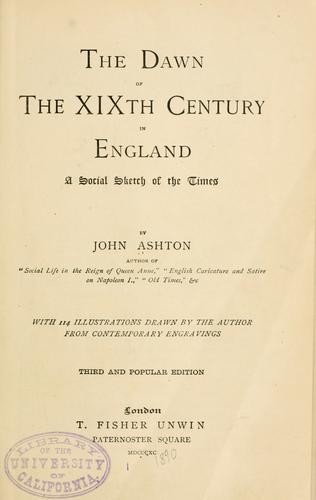
The Dawn of the XIXth Century in England: A social sketch of the timesAshton, John
History
The Dawn of the XIXth Century in England: A social sketch of the times
Ashton, John
England -- Social life and customs -- 19th century
When in full uniform, a sailor in the Royal Navy was a sight to
see—with his pig-tail properly clubbed and tied with black silk. We
have already seen them in the picture of Nelson’s funeral car, and the
accompanying illustration is of the same epoch, and shows a British
sailor weeping over Lord Nelson’s death.
It was a rough school, both for officers and men. We may judge somewhat
of what the life of the former was like by Captain Marryat’s novels;
but, lest they should be highly coloured, let us take a few lines from
the first page of the “Memoir of Admiral Sir Edward Codrington”:[73]
[Illustration: BRITISH SAILOR—1805.]
“He spent nine years at sea as a midshipman; and I have repeatedly
heard him say, that during those nine years (so important for the
formation of character) he never was invited to open a book, nor
received a word of advice or instruction, except professional, from any
one. More than that, he was thrown among a set in the gun-room mess,
older than himself, whose amusement it was—a too customary amusement
in those days—to teach the lad to drink, and to lead him into their
own habitual practice in that respect.”
If this was the case with the officers, how did the men fare? Volunteer
recruits did not come from the pick of the labouring class, and the
pressed men soon fell into the ways of those surrounding them. No
doubt they were better off in the Royal Navy than in the Mercantile
Marine; but the ship’s stores of that day consisted but of salt pork,
and beef, the latter being indifferently called _junk_ or _old horse_.
The biscuits, too, were nothing like those now supplied on board Her
Majesty’s ships. Wheat was very dear, and these sailors did not
get the best of that. Inferior corn, bad package, and old age soon
generated weevils, and the biscuit, when these were knocked out, was
often but an empty shell. Bullied by their officers, and brutally
flogged and punished for trifling faults, Jack’s life could not have
been a pleasant one; and we can hardly wonder that he often deserted,
and sometimes mutinied. Yet, whenever a fight was imminent, or did
actually occur, all bad treatment was banished from his mind, and he
fought like a Briton.
And there were many ships to man. Not only were all our dockyards hard
at work building and repairing, but prizes were continually coming in;
and the French men-of-war were better designed than ours—in fact,
it may be said that we learned, at that time, our Naval Architecture
from the prizes we took. In October, 1804, there were in commission
103 ships of the line, 24 fifty-gun vessels, 135 frigates, and 398
sloops—total 660. In March, 1806, there were 721 ships in commission,
of which 128 were of the line. On January 1, 1808, there were 795 in
commission, 144 being ships of the line. Many of these were taken
from the French, as the following exultant paragraph from the _Annual
Register_, August 19, 1808, will show:
Public-domain text, read in full here on John Shaqi.
Reviews
Reviews
No reviews yet
Be the first to share your thoughts on this work.
Elsewhere in the archive
Join the Discussion
Join the discussion
Sign in to leave a comment or review.
Sign InorCreate an account