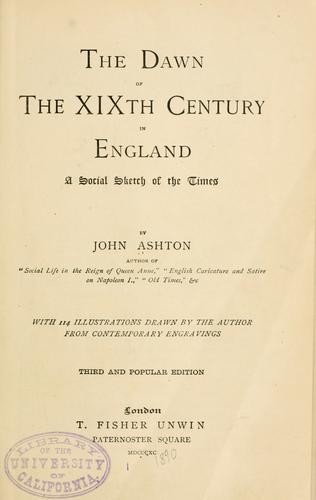
The Dawn of the XIXth Century in England: A social sketch of the timesAshton, John
History
The Dawn of the XIXth Century in England: A social sketch of the times
Ashton, John
England -- Social life and customs -- 19th century
The _Hermione_, also, was carried over to the enemy by a mutinous crew;
but in October, 1800, was cut out of Porto Cavello, after a gallant
resistance, by the boat’s crew of the _Surprise_, Captain Hamilton,
and brought in triumph to Port Royal, Jamaica. On this occasion
justice overtook two of the mutineers, who were hanged on the 14th of
August—one in Portsmouth Harbour, the other at Spithead. Another of
the mutineers, one David Forester, was afterwards caught and executed,
and, before he died, he confessed (_Annual Register_, April 19, 1802),
“That he went into the cabin, and forced Captain Pigot overboard,
through the port, while he was alive. He then got on the quarter deck,
and found the first lieutenant begging for his life, saying he had a
wife and three children depending on him for support; he took hold of
him, and assisted in heaving him overboard alive, and declared he did
not think he would have taken his life had he not first took hold of
him. A cry was then heard through the ship that Lieutenant Douglas
could not be found: he took a lantern and candle, and went into the
gun-room, and found the Lieutenant under the marine officer’s cabin. He
called in the rest of the people, when they dragged him on deck, and
threw him overboard. He next caught hold of Mr. Smith, a midshipman; a
scuffle ensued, and, finding him likely to get away, he struck him with
his tomahawk, and threw him overboard. The next cry was for putting all
the officers to death, that they might not appear as evidence against
them, and he seized on the Captain’s Clerk, who was immediately put to
death.”
I have to chronicle yet one more mutiny, happily not so tragical as the
last, but ending in fearful punishment to the mutineers. It occurred
principally on board the _Temeraire_ then in Bantry Bay, but pervaded
the squadron; and the culprits were tried early in January, 1802,
by a court martial at Portsmouth, for “using mutinous and seditious
words, and taking an active part in mutinous and seditious assemblies.”
Nineteen were found guilty, twelve sentenced to death, and ten,
certainly, hanged.
There seems to have been no grumble about their pay, or food, or
accommodation—a sea life was looked upon as a hard one, and accepted
as such. The officers, at all events, did not get paid too well, for we
read in the _Morning Post_, October 19, 1801: “We understand the Post
Captains in the Navy are to have eight shillings a day instead of six.
And it is supposed that Lieutenants will be advanced to four shillings
instead of three.” They occasionally got a haul in prize money—like
the _Lively_, which in August, 1805, was awarded the sum of £200,000
for the capture of some Spanish frigates.[74]
Public-domain text, read in full here on John Shaqi.
Reviews
Reviews
No reviews yet
Be the first to share your thoughts on this work.
Elsewhere in the archive
Join the Discussion
Join the discussion
Sign in to leave a comment or review.
Sign InorCreate an account