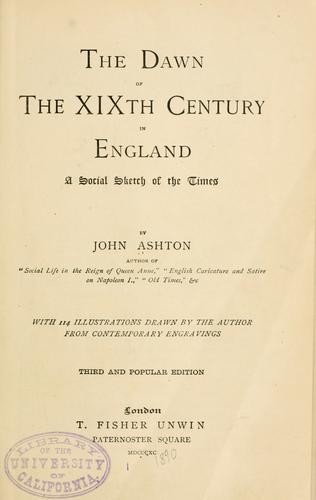
The Dawn of the XIXth Century in England: A social sketch of the timesAshton, John
History
The Dawn of the XIXth Century in England: A social sketch of the times
Ashton, John
England -- Social life and customs -- 19th century
Spite of everything, the naval power of England reached the highest
point it has ever attained, and no matter whatever grievances they may
have been suffering from, the sailors, from the admiral to the powder
monkey, behaved nobly in action, and, between the Navy and Army, we
had rather more prisoners of war to take care of than was agreeable.
Speaking of an exchange of prisoners, the _Morning Post_, October
15, 1810, says: “There are in France, of all kinds of prisoners and
detained persons, about 12,000; in England there are about 50,000
prisoners,” and the disproportion was so great that terms could not be
come to.
[Illustration]
[Illustration]
CHAPTER XLVIII.
The Army—Number of men—Dress—Hair-powder—Militia—Commissions
easily obtained—Price of substitutes—The Volunteers—Dress of the
Honourable and Ancient Artillery Company—Bloomsbury Volunteers, and
Rifle Volunteers—Review at Hatfield—Grand rising of Volunteers in
1803.
IN THE year 1800, our Army consisted of between 80,000 and 90,000 men,
besides the foreign legions, such as the Bavarians, in our pay. In
1810, there were 105,000, foreigners not included.
The British soldier of that day was, outwardly, largely compounded of
a tight coat and gaiters, many buttons and straps, finished off with
hog’s lard and flour; and an excellent representation of him, in the
midst of the decade, is taken from a memorial picture of the death
of Nelson, and also from his funeral; but these latter may have been
volunteers, as they were much utilized on that occasion. Be they what
they may, both had one thing in common—the pig-tail—which was duly
soaped, or larded and floured, until flour became so scarce that its
use was first modified, and then discontinued, about 1808. Otherwise
the variety of uniforms was infinite, as now.
Of the threatened Invasion I have already treated. Of the glorious
campaigns abroad I have nothing to say, except that all did their duty,
or more, with very few blunders, if we except the Expedition to the
Scheldt. From the highest to the lowest, there was a wish to be with
the colours. Fain would the Prince of Wales have joined any regiment
of which he was colonel, on active service, and, in fact, he made
application to be allowed to do so, but met with a refusal, at which he
chafed greatly. Should any one be curious to read the “Correspondence
between His Majesty, The Prince of Wales, the Duke of York, and Mr.
Addington, respecting the Offer of Military Service made by His Royal
Highness the Prince of Wales,” it can be found in the appendix to the
chronicle of the _Annual Register_ for 1803, pp. 564, &c.
Public-domain text, read in full here on John Shaqi.
Reviews
Reviews
No reviews yet
Be the first to share your thoughts on this work.
Elsewhere in the archive
Join the Discussion
Join the discussion
Sign in to leave a comment or review.
Sign InorCreate an account