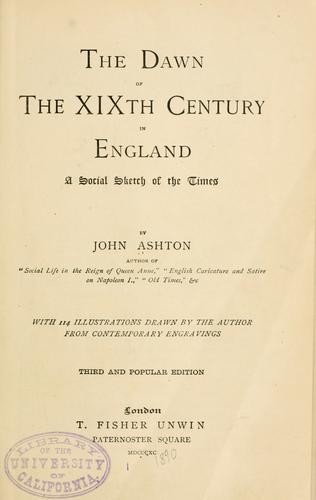
The Dawn of the XIXth Century in England: A social sketch of the timesAshton, John
History
The Dawn of the XIXth Century in England: A social sketch of the times
Ashton, John
England -- Social life and customs -- 19th century
I have no wish to go into the minute details of this scandal, but on
January 27, 1809, G. Lloyd Wardell,[78] Esq., M.P. for Oakhampton,
began his indictment of the Duke of York, in this matter, before the
House of Commons; and he showed that every sale effected through Mrs.
Clarke’s means, was a robbery of the Half Pay Fund, and he asked for a
Parliamentary Committee to investigate the affair; this was granted,
and Mrs. Clarke, and very numerous witnesses were examined. The
lady was perfectly self-possessed, and able to take care of herself;
and the evidence, all through, was most damaging to the Duke. Mrs.
Clarke is thus described in the _Morning Post_ of Friday, February 3,
1809: “Mrs. Clarke, when she appeared before the House of Commons, on
Wednesday, was dressed as if she had been going to an evening party,
in a light blue silk gown and coat, edged with white fur, and a white
muff. On her head she wore a white cap, or veil, which at no time was
let down over her face. In size she is rather small, and does not
seem to be particularly well made. She has a fair, smooth skin, and
lively blue eyes, but her features are not handsome. Her nose is rather
short and turning up, and her teeth are very indifferent; yet she has
the appearance of great vivacity of manners, but is said not to be a
well-bred or accomplished woman. She appears to be about thirty-five
years of age.”
[Illustration: THE PRODIGAL SON’S RESIGNATION.]
The Duke took the extraordinary course of writing a letter to the
Speaker of the House of Commons, whilst the matter was _sub judice_, in
which he asserted his innocence; and, foreseeing what was to follow,
gave out that for the future he meant to be a very good boy, and that
he would retrench in his expenditure, in order to attempt to liquidate
his debts.
The House eventually found that there was nothing in the evidence to
prove personal corruption, or criminal connivance on the part of His
Royal Highness; but, although thus partially whitewashed, the public
opinion against him was too strong, and he placed his resignation, as
Commander in Chief, in the King’s hands.
Places were openly bought and sold, although it was known to be
illegal, such advertisements as the following being common—_Morning
Post_, June 14, 1800:
“PUBLIC OFFICES.
“A YOUNG MAN of good Connections, well educated in writing and
accounts, and can find security, wishes for a Clerkship in any of the
Public Offices. Any Lady or Gentleman having interest to procure such
a situation, will be presented with the full value of the place. The
greatest secrecy and honour will be observed.”
So common were they, that it was found necessary to issue notices on
the subject. Here is one:
“_Custom House, London, December 7, 1802._
Public-domain text, read in full here on John Shaqi.
Reviews
Reviews
No reviews yet
Be the first to share your thoughts on this work.
Elsewhere in the archive
Join the Discussion
Join the discussion
Sign in to leave a comment or review.
Sign InorCreate an account