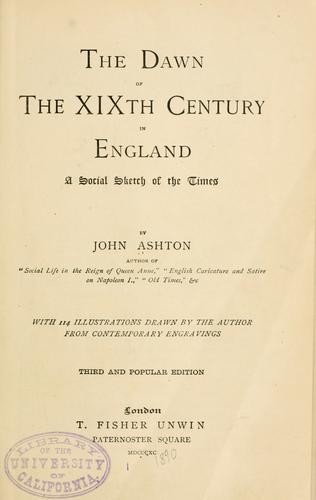
The Dawn of the XIXth Century in England: A social sketch of the timesAshton, John
History
The Dawn of the XIXth Century in England: A social sketch of the times
Ashton, John
England -- Social life and customs -- 19th century
“WHEREAS Advertisements have, at different times, appeared in the
Newspapers, offering Sums of Money for the procuring of Places, or
Situations, in the Customs, inserted either by persons not aware
of the serious consequences which attach upon transactions of this
nature, or by persons of a different description, with a view to
delude the ignorant, and unwary: The Commissioners of His Majesty’s
Customs think it necessary to have it generally made known that, in
addition to the punishment which the Common Law would inflict upon
the offence of bribing, or attempting to bribe, any person entrusted
with the disposal of any Office, the Statute passed in the fifth and
sixth year of the reign of King Edward the Sixth, inflicts the penalty
of incapacity to hold such office in the person purchasing, and the
forfeiture of office in the person selling; and that in case any
such place or situation, either shall have been, or shall hereafter
be procured, or obtained, by such Corrupt means, they are determined
to enforce the penalties of the Law, and to prosecute the offenders
with the utmost severity. And they do hereby promise a Reward of One
Hundred Pounds, to any person or persons who will give information and
satisfactory proof, of any place or situation in the Customs being
so obtained, so that the parties concerned therein may be proceeded
against accordingly.”
Duels were most frequent, so much so, as not to excite any interest
in the student of history of that time, for it is difficult to pick
up a newspaper and not find one recorded. The reasons are not always
given, but it did not take much to get up a duel; any excuse would
serve. As an example, let us take the duel between Colonel Montgomery,
and Captain Macnamara, at Chalk Farm (April, 1803) in which the former
was killed, and the latter wounded. Lord Burghersh, in giving evidence
before the coroner’s jury, said: “On coming out of St. James’s Park
on Wednesday afternoon, he saw a number of horsemen, and Colonel
Montgomery among them; he rode up to him; at that time, he was about
twenty yards from the railing next to Hyde Park Gate. On one side of
Colonel Montgomery was a gentleman on horseback, whom he believed was
Captain Macnamara. The first words he heard were uttered by Colonel
Montgomery, who said: ‘Well, Sir, and I will repeat what I said,
if your dog attacks mine, I will knock him down.’ To this, Captain
Macnamara replied, ‘Well, Sir, but I conceive the language you hold is
arrogant, and not to be pardoned.’ Colonel Montgomery said: ‘This is
not a proper place to argue the matter; if you feel yourself injured,
and wish for satisfaction, you know where to find me.’” And so these
two poor fools met, and one was killed—all because two dogs fought,
and their masters could not keep their temper!
[Illustration]
[Illustration]
CHAPTER LI.
Public-domain text, read in full here on John Shaqi.
Reviews
Reviews
No reviews yet
Be the first to share your thoughts on this work.
Elsewhere in the archive
Join the Discussion
Join the discussion
Sign in to leave a comment or review.
Sign InorCreate an account