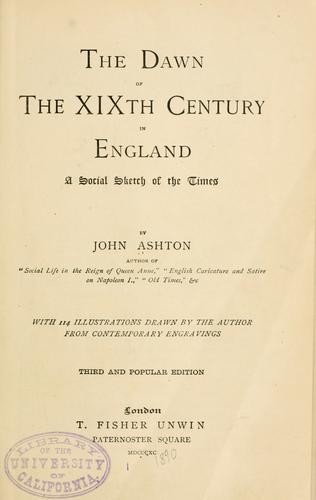
The Dawn of the XIXth Century in England: A social sketch of the timesAshton, John
History
The Dawn of the XIXth Century in England: A social sketch of the times
Ashton, John
England -- Social life and customs -- 19th century
Crime then was very much what it is now; there is very little new under
the sun in wickedness—still, the _Morning Post_ of February 3, 1800,
has the
“FIRST NEW MODE OF ROBBING
in 1800.
“A few days past, a man entered a little public-house, near Kingston,
called for a pint of ale, drank it, and, whilst his host was away,
put the pot in his pocket, and, without even paying for the beer,
withdrew. The landlord, returning, two other men, who were in the
room, asked him whether he knew the person who had just left the
house? ‘No,’ he replied. ‘Did he pay for the ale?’ said they. ‘No,’
answered the other. ‘Why, d—n him,’ cried one of the guests, ‘he put
the pot in his pocket.’ ‘The devil, he did!’ exclaimed the host, ‘I
will soon be after him.’
“Saying this, he ran to the door, and the two men with him. ‘There,
there, he’s going round the corner now!’ said one, pointing. Upon
which the landlord immediately set off, and, cutting across a field,
quickly came up to him. ‘Holloa! my friend,’ said he, ‘you forgot to
pay for your beer.’ ‘Yes,’ replied the other, ‘I know that!’ ‘And,
perhaps you know, too,’ added the host, ‘that you took away the pot?
Come, come, I must have that back again, at any rate.’ ‘Well, well,’
said the man, and put his hand into his pocket, as if about to return
the pot; but, instead of that, he produced a pistol, and robbed the
ale-house keeper of his watch and money.
“This might seem calamity enough for the poor man; but, to fill up his
cup of misfortune to the brim, he found, on reaching his home, that
the two he had left behind, had, during his absence, plundered his
till, stolen his silver spoons, and decamped.”
One of the most audacious robberies of those ten years, was one which
took place on September 21, 1801, when the House of Lords was robbed
of all the gold lace, and the ornaments of the throne, the King’s arms
excepted, were stripped, and carried away. Nor was the thief ever found.
For minor offences the punishments were, Whipping, the Stocks, and the
Pillory; for graver ones, Imprisonment, Transportation, and DEATH.
As a specimen of the offence for which Whipping was prescribed, and
the whipping itself, take the following—_Morning Post_, November 4,
1800: “This day, being hay-market day at Whitechapel, John Butler,
pursuant to his sentence at the last General Quarter Sessions, held at
Clerkenwell, is to be publicly whipped from Whitechapel Bars, to the
further end of Mile End, Town, the distance of two miles, for having
received several trusses of hay, knowing them to have been stolen, and
for which he gave an inferior price.”
Public-domain text, read in full here on John Shaqi.
Reviews
Reviews
No reviews yet
Be the first to share your thoughts on this work.
Elsewhere in the archive
Join the Discussion
Join the discussion
Sign in to leave a comment or review.
Sign InorCreate an account