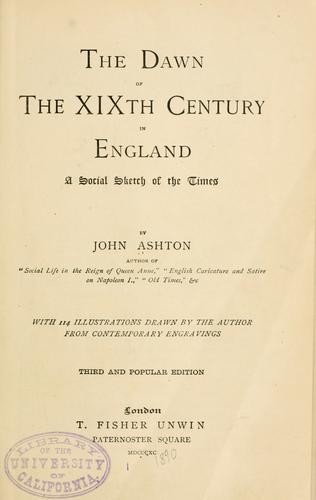
The Dawn of the XIXth Century in England: A social sketch of the timesAshton, John
History
The Dawn of the XIXth Century in England: A social sketch of the times
Ashton, John
England -- Social life and customs -- 19th century
The Stocks were only for pitiful rogues and vagabonds, and for very
minor offences; but the Pillory, when the criminals were well known,
and the crime an heinous one, must have been a very severe punishment;
for, setting aside the acute sense of shame which such publicity must
have awoke in any heart not absolutely callous, the physical pain, if
the mob was ill-tempered, must have been great. As a proof, I will give
two instances.
The first is from the _Morning Herald_, January 28, 1804: “The
enormity of Thomas Scott’s offence, in endeavouring to accuse Capt.
Kennah, a respectable officer, together with his servant, of robbery,
having attracted much public notice, his conviction, that followed
the attempt, could not but be gratifying to all lovers of justice.
Yesterday, the culprit underwent a part of his punishment; he was
placed in the pillory, at Charing Cross, for one hour. On his first
appearance, he was greeted by a large mob, with a discharge of _small
shot_, such as _rotten eggs_, _filth_, and _dirt_ from the streets,
which was followed up by dead cats, rats, &c., which had been collected
in the vicinity of the Metropolis by the boys in the morning. When he
was taken away to Cold Bath Fields, to which place he is sentenced for
twelve months, the mob broke the windows of the coach, _and would have
proceeded to violence_[79] had the Police Officers not been at hand.”
[Illustration: PILLORY. CHARING CROSS.]
The other is taken from the _Annual Register_, September 27, 1810:
“Cooke, the publican of the Swan, in Vere Street, Clare Market, and
five others of the eleven miscreants convicted of detestable practices,
stood in the pillory in the Haymarket, opposite to Panton Street. Such
was the degree of popular indignation excited against these wretches,
and such the general eagerness to witness their punishment that by ten
in the morning, all the windows and even the roofs of the houses were
crowded with persons of both sexes; and every coach, waggon, hay-cart,
dray, and other vehicle which blocked up great part of the streets,
were crowded with spectators.
[Illustration: THE PILLORY.]
“The Sheriffs, attended by the two City marshals, with an immense
number of constables, accompanied the procession of the prisoners from
Newgate, whence they set out in the transport caravan, and proceeded
through Fleet Street and the Strand; and the prisoners were hooted
and pelted the whole way by the populace. At one o’clock, four of the
culprits were fixed in the pillory, erected for, and accommodated to,
the occasion, with two additional wings, one being allotted to each
criminal. Immediately a new torrent of popular vengeance poured upon
them from all sides; blood, garbage, and ordure from the slaughter
houses, diversified with dead cats, turnips, potatoes, addled eggs, and
other missiles to the last moment.
Public-domain text, read in full here on John Shaqi.
Reviews
Reviews
No reviews yet
Be the first to share your thoughts on this work.
Elsewhere in the archive
Join the Discussion
Join the discussion
Sign in to leave a comment or review.
Sign InorCreate an account