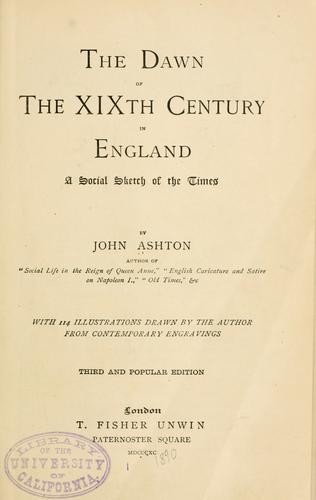
The Dawn of the XIXth Century in England: A social sketch of the timesAshton, John
History
The Dawn of the XIXth Century in England: A social sketch of the times
Ashton, John
England -- Social life and customs -- 19th century
“Tyburn” reminds us of the fearful numbers sentenced to death at that
time. The law sadly wanted reformation in this respect; besides murder,
coining, forgery, &c., many minor offences were punishable with death,
although all convicted and sentenced were not executed; some being
reprieved, and punished with transportation. George III. had a great
dislike to capital punishment, and remitted the sentence to as many as
he could. Take as an example of the awful severity of the law, only one
sessions at the Old Bailey, ending September 24, 1801: “Sentence of
death was then passed upon _Thomas Fitzroy_, alias _Peter Fitzwater_,
for breaking and entering the dwelling-house of James Harris, in the
daytime, and stealing a cotton counterpane. _Wm. Cooper_ for stealing a
linen cloth, the property of George Singleton, in his dwelling-house.
_J. Davies_ for a burglary. _Richard Emms_ for breaking into the
dwelling-house of Mary Humphreys, in the daytime, and stealing a pair
of stockings. _Richard Forster_ for a burglary. _Magnus Kerner_ for a
burglary, and stealing six silver spoons. _Robert Pearce_ for returning
from transportation. _Richard Alcorn_ for stealing a horse. _John
Nowland_ and _Rd. Freke_ for burglary and stealing four tea spoons, a
gold snuff-box, &c. _John Goldfried_ for stealing a blue coat. _Joseph
Huff_, for stealing a lamb, and _John Pass_ for stealing two lambs.”
[Illustration: THE CONDEMNED SERMON. NEWGATE.]
In fact, the “Tyburn tree” was kept well employed, and yet, apparently,
the punishment of death hardly acted as a deterrent. A sad, very sad
street cry, yet one I have often heard, was of these poor wretches;
true, it had been made specially to order, in Catnach’s factory for
these articles, in Monmouth Court, Seven Dials; but still it was the
announcement of another fellow-creature having been done to death.
The executions which would arise from the batch of sentences I have
just recorded, would take place at Newgate. The last person hanged at
Tyburn, having suffered, November 7, 1783, and the above illustration
shows in a peculiarly graphic manner, the _condemned sermon_, which
was preached to those about to die on the morrow. To make the service
thoroughly intelligible to them, and to impress them with the reality
of their impending fate, a coffin was set in the midst of the
“condemned pew.”
[Illustration: THE LAST DYING SPEECH AND CONFESSION.]
Crowds witnessed the executions, which took place in the front of
Newgate, and on one occasion, on the 23rd of February, 1807, an
accident occurred, by the breaking of the axle of a cart, whereon many
people were standing; they were not only hurt, but the crowd surged
over them, and it ended in the death of twenty-eight people, besides
injuries to many more.
Public-domain text, read in full here on John Shaqi.
Reviews
Reviews
No reviews yet
Be the first to share your thoughts on this work.
Elsewhere in the archive
Join the Discussion
Join the discussion
Sign in to leave a comment or review.
Sign InorCreate an account