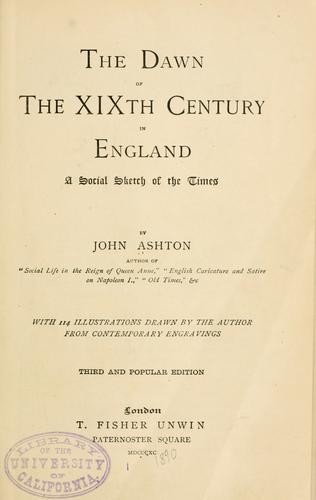
The Dawn of the XIXth Century in England: A social sketch of the timesAshton, John
History
The Dawn of the XIXth Century in England: A social sketch of the times
Ashton, John
England -- Social life and customs -- 19th century
Sometimes it was done wholesale, see the _Morning Herald_, February
17, 1802: “Last Thursday morning, the Brighton fishermen picked up at
sea, and brought to shore, at that place, upwards of five hundred casks
of Contraband spirits, of which the Revenue officers soon got scent,
and proceeded, very actively, to unburden the fishermen. This landing
and seizing continued, with little intermission, from six to ten, to
the great amusement of upwards of two thousand people, who had became
spectators of the scene. When the officers had loaded themselves with
as many tubs as they could carry, the fishermen, in spite of their
assiduity, found means to convey away as many more, and by that means
seemed to make a pretty equal division. The above spirits, it appeared,
had been thrown overboard by the crew of a smuggling vessel, when
closely chased by a Revenue Cutter.”
We may claim that one detestable offence, then rife, is now extinct. I
allude to “Body-snatching.” It is true that anatomists had, legally, no
way of procuring subjects to practise on, other than those criminals
who had been executed, and their bodies not claimed by their friends;
but, although the instances on record are, unfortunately numerous,
I have already written of them in another book, and once is quite
sufficient.
Of one or two legal curiosities now extinct, I may mention “Benefit of
Clergy,” an institution established in our early history, in order to
screen a clerk, or learned man, from the consequences of his crime.
In case of felony, one had but to plead ability to read, and prove it,
and the sentence was commuted to branding the hand with a hot iron. It
was a privilege much abused, but it lingered on until 1827, when it was
abolished by the Act, 7 and 8 Geo. IV. cap. 28.
Another curious custom, now also done away with, we meet with, in
an advertisement in the _Morning Herald_, March 17, 1802: “WANTED,
one or two Tyburn Tickets, for the Parish of St. George’s, Hanover
Square. Any person or persons having the same to dispose of, may hear
of a purchaser,” &c. These tickets were granted to a prosecutor who
succeeded in getting a felon convicted, and they carried with them
the privilege of immunity from serving all parochial offices. They
were transferable by sale (but only once), and the purchaser enjoyed
its privileges. They were abolished in 1818. They had a considerable
pecuniary value, and in the year of their abolition, one was sold for
£280!
Public-domain text, read in full here on John Shaqi.
Reviews
Reviews
No reviews yet
Be the first to share your thoughts on this work.
Elsewhere in the archive
Join the Discussion
Join the discussion
Sign in to leave a comment or review.
Sign InorCreate an account