Fathers and sons -- Fiction; Man-woman relationships -- Fiction; Young men -- Fiction
Produced by D Alexander, Juliet Sutherland and the Online
Distributed Proofreading Team at http://www.pgdp.net
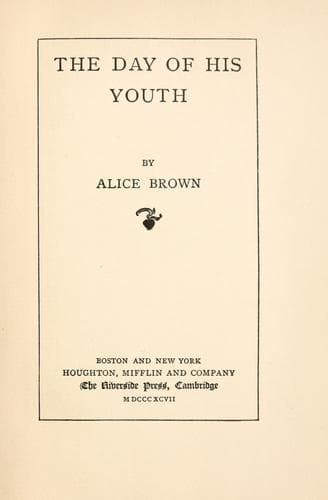
THE DAY OF HIS YOUTH
By
ALICE BROWN
BOSTON AND NEW YORK
HOUGHTON, MIFFLIN AND COMPANY
The Riverside Press, Cambridge
M DCCC XCVII
COPYRIGHT, 1897
BY ALICE BROWN
ALL RIGHTS RESERVED
THE RIVERSIDE PRESS, CAMBRIDGE, MASS., U.S.A.
ELECTROTYPED AND PRINTED BY
H. O. HOUGHTON AND CO.
THE DAY OF HIS YOUTH
The life of Francis Hume began in an old yet very real tragedy. His
mother, a lovely young woman, died at the birth of her child: an event
of every-day significance, if you judge by tables of mortality and the
probabilities of being. She was the wife of a man well-known among
honored American names, and her death made more than the usual ripple
of nearer pain and wider condolence. To the young husband it was an
afflicting calamity, entirely surprising even to those who were
themselves acquainted with grief. He was not merely rebellious and
wildly distraught, in the way of mourners. He sank into a cold
sedateness of change. His life forsook its accustomed channels. Vividly
alive to the one bright point still burning in the past, toward the
present world he seemed absolutely benumbed. Yet certain latent
conceptions of the real values of existence must have sprung up in him,
and protested against days to be thereafter dominated by artificial
restraints. He had lost his hold on life. He had even acquired a sudden
distaste for it; but his previous knowledge of beauty and perfection
would not suffer him to shut himself up in a cell of reserve, and
isolate himself thus from his kind. He could become a hermit, but only
under the larger conditions of being. He had the firmest conviction
that he could never grow any more; yet an imperative voice within bade
him seek the highest out-look in which growth is possible. He had
formed a habit of beautiful living, though in no sense a living for any
other save the dual soul now withdrawn; and he could not be satisfied
with lesser loves, the makeshifts of a barren life. So, turning from
the world, he fled into the woods; for at that time Nature seemed to
him the only great, and he resolved that Francis, the son, should be
nourished by her alone.
One spring day, when the boy was eight years old, his father had said
to him:--
"We are going into the country to sleep in a tent, catch our own fish,
cook it ourselves, and ask favors of no man."
"Camping!" cried the boy, in ecstasy.
"No; living."
Public-domain text, read in full here on John Shaqi.
Reviews
Reviews
No reviews yet
Be the first to share your thoughts on this work.
Join the Discussion
Join the discussion
Sign in to leave a comment or review.
Sign InorCreate an account