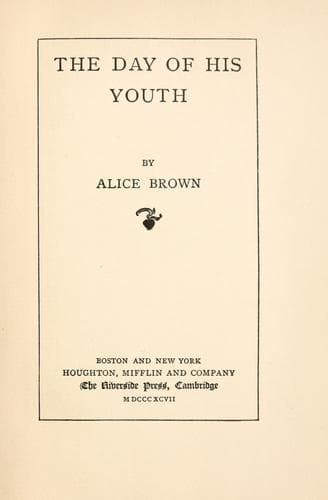
Fathers and sons -- Fiction; Man-woman relationships -- Fiction; Young men -- Fiction
Tenderness and constancy! that, my child, is friendship--it is not
love. And I can gather a very good article of friendship from many a
wayside bush without going over hot ploughshares to seek it. Listen,
and I will tell you exactly how I learned to interpret the later course
of passion. I lived and breathed it side by side and heart to heart
with a woman once. I will not tell you her name; she is living, and
some time you may know her. I had a friend, and I loved her. She
married a man who worshiped her, who was intoxicated by her as you are
by me. He was her slave, if I may say that of one who took more than he
bestowed; but though he absorbed her life and narrowed it in certain
ways, he made her divinely happy. So it went on for years, until
suddenly, through some new combination of circumstances, they were
separated for a time, and he woke up. O telltale phrase in the life of
a man! You don't know how much it means now, but you will know. She was
dazed, confounded. Not that he was unkind to her; he was a gentleman,
though a gentleman grown indifferent. About that time he drifted into
friendship with another woman, led thereto, he would have said, by
their kindred tastes. Nothing vicious here, nothing to distress the
taste of law-abiding citizens; but a tragedy of the soul. I wonder if I
can paint it for you. Here was a passionately devoted wife, taught by
every act and word and look of years to depend for happiness on one
living creature: to turn to him, as to the sun, for life and
nourishment. Suddenly the sun was withdrawn, the light went out; she
was expected to see by candle. Do not imagine that she betrayed him to
me; we are not like that. I knew because she was so dear to me, and I
had lived beside her and learned her thoughts. I felt the tragedy as it
was enacted, day by day. I saw her poor face sodden with weeping. I
suppose she reproached him at first, wildly, in woman's way. I suppose
that because I knew him to be angry and bored. But when she saw little
winning attentions which had once been hers given to another, I think
it began to dawn upon her that they had never meant anything from the
first. They were subjective, if I may put it so: a part of the man's
nature, the trophy of any one who knew the password. Then the whole
woman hardened. She reproached him no more. If he showered on her some
of the unspent coin of his affection, she took it graciously, not
treasuring it even in thought; because she dared not build again a
house upon the sand. Her individuality grew mightily meantime. She
became a creature of a wonderful strength and depth of thought; but her
heart is dead within her. Sometimes I can see that she is even amused,
in a pathetic way, at finding how lightly his indifference can pass
over her. Now this was a good man, as men go. He would have scorned a
sin larger than this romantic peccadillo,--but he was a man! He had
waked up and found himself bored. And so would you! So far as I have
Public-domain text, read in full here on John Shaqi.
Reviews
Reviews
No reviews yet
Be the first to share your thoughts on this work.
Join the Discussion
Join the discussion
Sign in to leave a comment or review.
Sign InorCreate an account