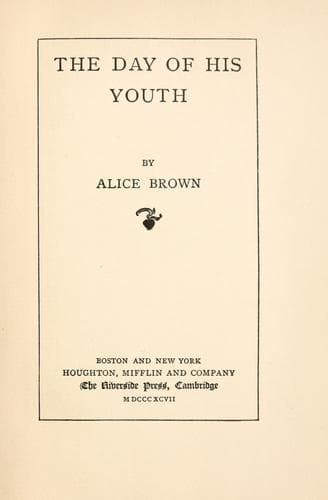
Fathers and sons -- Fiction; Man-woman relationships -- Fiction; Young men -- Fiction
Have I done well? Here have I written you page upon page, only to earn
a letter in return, when I long to fill these sheets with hot
protestations, with petitions for your gentle ruth. At first it was
enough to love you. At first? for the instant of recognizing my royal
destiny; but now I would have all. Love me! love me! my heart cries and
cries, for unless you know me for your own, what shall hinder me from
losing you in this whirling progress of the days. You will go away; I
heard them talking about it this morning. What am I to do then, I ask
you? What am I to do? Mateless, solitary, left in the nest I was so
long in building, while you fly south, the sun upon your shining wings.
_What am I to do?_
[Sidenote: _Zoe Montrose to Francis Hume_]
Your last letter pleased me very well, all save its note of melancholy.
Byronism is out of fashion. It isn't vendible, or it won't be in a few
years, mark my words. In the time that is coming, men-children will
rise up in literature and slash and slay and troll out hearty songs,
born in the childhood of the race, and tell us of the love of woman,
and the joy of martial blows. No more splitting of psychological hairs!
The reaction is coming, and I thank the gods who make for us to mar.
Moreover, you were hysterical at the end. Reform it altogether. No
woman of any sense of humor was ever won by tears in the man who should
be fighting for her. Take Tristram of Brittany for your model, not some
laddie who should be in petticoats. Else you will never win fair lady.
I speak generally, for it is understood from the start that this
specific fair lady is not to be won at all. Woo her you may, so you do
it amusingly, robustly, with no whining like a hungry dog. She has
little heart for "crumbling the hounds their messes." Now to business.
I lay my commands upon you. A visitor is coming to camp: a man. While
he is here, I shall have no time either to write or read, and I shall
not visit the hollow tree. Moreover, you, as you be loyal and true, are
to treat him fairly and kindly. If you hate my tendance of him as a
stranger and a guest, you are to be only the more courteous. In short,
as a knight peerless, you are to suffer manfully and in silence. For in
silence lies the only true dignity left us by the chances of life. You
see I own at once that you will suffer. That is inevitable; but I ask
you to take the screw like a gentleman. There is no better word yet
made.
[Sidenote: _To the Unknown Friend_]
I am forbidden to write her. I must speak to some one, to something. He
came three days ago. He is tall, black-eyed, with a laugh that rings.
When I hear that laugh, I cannot even moisten my dry tongue. I have
learned the meaning of hate. Yesterday she ran to the spring to bring
him a glass of water. (He lay lazily and let her.) I followed.
"Is that the man you said you might love?" I whispered.
Public-domain text, read in full here on John Shaqi.
Reviews
Reviews
No reviews yet
Be the first to share your thoughts on this work.
Join the Discussion
Join the discussion
Sign in to leave a comment or review.
Sign InorCreate an account