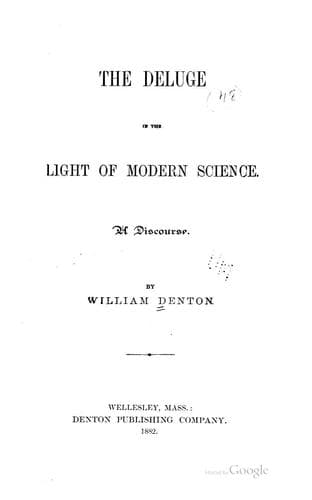
The Deluge in the Light of Modern Science: A DiscourseDenton, William
Religion
The Deluge in the Light of Modern Science: A Discourse
Denton, William
Bible and science; Deluge
There must have been obtained four elephants, for there are two species,
the Asiatic and the Indian; fourteen rhinoceroses, one of which is found
only in South Africa, another in the island of Java, and a third in
Sumatra; two hippopotami, and possibly four, for some authorities say
there are two species. Fourteen giraffes, since they are clean beasts,
must have been caught and driven from Central Africa (many more, indeed,
must have been caught, that the required number might reach the ark and
be preserved); twenty-eight camels, two hundred and eighty oxen (for
there are twenty species, and they are clean); and no less than thirteen
hundred and eighty-six deer and antelope, of which there are ninety-nine
species recognized: these to be collected in various parts of Europe,
Asia, Northern and Southern Africa, and America.
New Zealand must have been visited to obtain its wingless birds;
Mauritius for its dodo, then living; Australia for its marsupials and
other peculiar animals; and every large island, and most of the small
ones, to obtain those forms of life that are only to be found in each.
From the island of Celebes, they must have taken the eighty species of
birds that are confined to it, which would require them to catch, cage,
feed, and convey eleven hundred and twenty specimens: a no small job of
itself. Ten men that could accomplish that, and carry them safe to
Armenia, would do all that men could do in ten years. From the
Philippine Islands, the seventy-three species of hawks, parrots, and
pigeons, peculiar to them; which would require, since fourteen of every
kind of bird were to be taken into the ark, no less than one thousand
and twenty-two specimens. From New Guinea, and the neighboring islands,
two hundred and fifty-two of the magnificent birds of paradise, since
there are eighteen species.
A faint idea of the difficulties encountered and overcome by Noah's
agents may be gathered from what Wallace, in his recent work on the
Malay Archipelago, informs us respecting these birds of paradise. "Five
voyages to different parts of the district they inhabit, each occupying
in its preparation and execution the larger part of a year, produced me
only five species out of the fourteen known to exist in the New-Guinea
district." If it took Wallace, with all the assistance that he had from
various officials, five years to obtain five species, represented by
dead birds, how long did it take Noah's agents to obtain eighteen
species represented by two hundred and fifty-two live birds? Wallace
could only obtain two alive, and for these he had to pay five hundred
dollars.
If the antediluvian sinners were any thing like the modern ones, Noah
must have been richer than the Rothschilds, or he never could have
obtained their services; which he must have done, or it could never be
truthfully said, "according to all that God commanded him, so did he."
Public-domain text, read in full here on John Shaqi.
Reviews
Reviews
No reviews yet
Be the first to share your thoughts on this work.
Join the Discussion
Join the discussion
Sign in to leave a comment or review.
Sign InorCreate an account