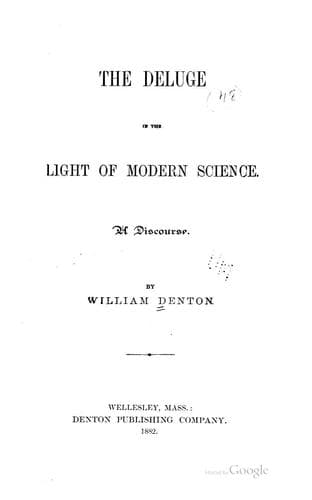
The Deluge in the Light of Modern Science: A DiscourseDenton, William
Religion
The Deluge in the Light of Modern Science: A Discourse
Denton, William
Bible and science; Deluge
Into this were to be taken fourteen of each kind of fowl of the air or
bird. How many kinds or species of birds are there? When Adam Clarke
wrote his commentary, two thousand three hundred and seventy-two species
had been recognized. Ornithology was then but in its infancy, and man's
knowledge of living forms was very limited. Lesson, according to Hugh
Miller, enumerates the birds at six thousand two hundred and sixty-six
species; Gray, in his "Genera of Birds," estimates the number on the
globe at eight thousand. Let us not crowd Noah, but take the six
thousand two hundred and sixty-six species of Lesson. Fourteen of each
of these would give us eighty-seven thousand seven hundred and
twenty-four birds,--from the humming-bird, the little flying jewel, to
the ostrich that fans the heated air of the desert,--or over five for
every yard of standing-room in the ark. If spaces were left for the
attendants to pass among them, to attend to the supply of their daily
wants, the birds alone would crowd the ark.
But, beside the birds, there were to be taken into the ark two of every
sort of unclean beast and fourteen of every sort of clean beast. The
most recent zoölogical authorities enumerate two thousand and
sixty-seven species of mammals, or, as they are commonly called, beasts.
Of cetacea, or whale-like mammals, sixty-five; ruminantia, or
cud-chewers, one hundred and seventy-seven; pachydermata, or
thick-skinned mammals, such as the horse, hog, and elephant, forty-one;
edentata, like the sloth and ant-eater, thirty-five; rodentia, or
gnawers, such as the rat, squirrel, and beaver, six hundred and
seventeen; carnivora, or flesh-eaters, four hundred and forty-six;
cheiroptera, or bats, three hundred and twenty-eight; quadrumana, or
monkeys, two hundred and twenty-one; and marsupialia, or pouched
mammals, like the opossum and kangaroo, one hundred and thirty-seven. If
we leave out the cetacea, that live in the water, and the cud-chewers,
which are the clean beasts, we have one thousand eight hundred and
twenty-five species; and male and female of these, a total of three
thousand six hundred and fifty.
Public-domain text, read in full here on John Shaqi.
Reviews
Reviews
No reviews yet
Be the first to share your thoughts on this work.
Join the Discussion
Join the discussion
Sign in to leave a comment or review.
Sign InorCreate an account