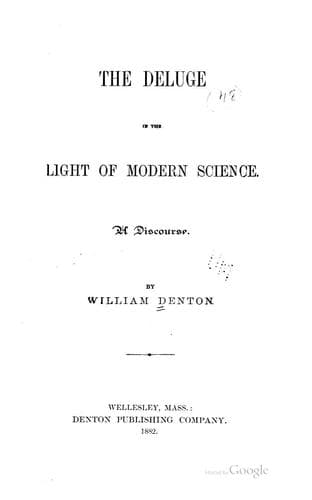
The Deluge in the Light of Modern Science: A DiscourseDenton, William
Religion
The Deluge in the Light of Modern Science: A Discourse
Denton, William
Bible and science; Deluge
Many animals live upon insects; and this must have been the most
difficult part of the provision to procure. There are nineteen species
of goatsuckers; and there must have been in the ark two hundred and
sixty-six individuals. These birds feed upon flies, moths, beetles, and
other insects. What an innumerable multitude must have been provided for
the goatsuckers alone! But there are a hundred and thirty-seven species
of fly-catchers; and Noah must have had a fly-catcher family of nineteen
hundred and eighteen individuals to supply with appropriate food. There
are thirty-seven species of bee-eaters; and there must have been five
hundred and eighteen of these birds to supply with bees. A very large
apiary would be required to supply their needs. But, beside these,
insects for swallows, swifts, martins, shrikes, thrushes, orioles,
sparrows, the beautiful trogans and jacamars, moles, shrews, hedgehogs,
and a multitude of others, too numerous to mention, but not too numerous
to eat. Ants, also, for the ant-eaters of America, the aard-vark of
Africa, and the pangolin of Asia. The great ant-eater of South America
is an animal sometimes measuring eight feet in length. It lives
exclusively on ants, which it procures by tearing open their hills with
its hooked claws, and then drawing its long tongue, which is covered
with glutinous saliva, over the swarms which rush out to defend their
dwelling. Many bushels of ants would be needed for the pair of
ant-eaters before the ark landed on Ararat. How were all the insects
caught, and kept for the use of all these animals for more than a year?
A hundred men could not catch a sufficient number in six months. And, if
caught, how could they be preserved, together with the original stock of
insects necessary to supply the world after the deluge? Some insects eat
only bark; others, resinous secretions, the pith, solid wood, leaves,
sap in the veins, as the aphid, flowers, pollen, and honey. Wood, bark,
resin, and honey might have been supplied; but how could green leaves,
sap, flowers and pollen, be furnished to those insects absolutely
requiring them for existence? Thirty species of insects feed on the
nettle, but not one of them could live on dried nettles. Rösel
calculates that two hundred species subsist on the oak; but the oak must
be in a growing condition to supply them with food. In no other way,
then, could the insects have been preserved alive than by large
green-houses, the heat so applied as to suit the plants of both
temperate and tropical climates, and the insects so distributed among
them, that each could obtain its appropriate nourishment.
Public-domain text, read in full here on John Shaqi.
Reviews
Reviews
No reviews yet
Be the first to share your thoughts on this work.
Join the Discussion
Join the discussion
Sign in to leave a comment or review.
Sign InorCreate an account