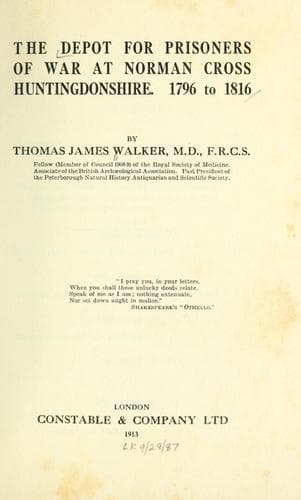
The Depot for Prisoners of War at Norman Cross, Huntingdonshire. 1796 to 1816Walker, Thomas (Thomas James)
History
The Depot for Prisoners of War at Norman Cross, Huntingdonshire. 1796 to 1816
Walker, Thomas (Thomas James)
France -- History -- 1789-1815; Norman Cross depot; Prisoners of war
“Whereas the Commissioners for conducting His Britannic Majesty’s
Transport Service, and for the Care and Custody of Prisoners of War,
have been pleased to grant me, the undersigned . . . . . . as
described on the back thereof, late . . . . . . and now a Prisoner of
War, leave to return to France, upon my entering into an Engagement
not to serve against Great Britain, or any of the Powers in Alliance
with that Kingdom, until I shall be regularly exchanged for a British
Prisoner of War, of equal Rank; and upon my also engaging, that
immediately after my Arrival in France, I shall make known the Place
of my Residence there, to the British Agent for Prisoners in Paris,
and shall not change the same on any account, without first
intimating my intention to the said Agent; and moreover, that at the
Expiration of every Two Months, until my exchange shall be effected,
I shall regularly and punctually transmit to the said Agent, a
Certificate of my Residence, signed by the Magistrates or Municipal
Officers of the Place.
“Now, in Consideration of my Engagement, I do hereby declare that I
have given my Parole of Honour accordingly, and that I will keep it
inviolable.
“Given under my Hand at . . . . . . this . . . . . . Day of 17 . . .
. . .
“_On back_, Name, Rank, Age, Stature, Person, Visage, Complexion,
Hair, Eyes, Marks or Wounds, etc.”
Further it must be borne in mind that military punishments are more
severe than civil; they follow more rapidly the crime. A breach of
parole was a military crime as well as a civil offence, for which loss of
liberty on a Chatham hulk was perhaps a fitting punishment. By Clause 4
of Rules to be observed by the prisoners of war in Great Britain,
Ireland, etc.—rules with which all prisoners, whether in captivity or on
parole, were familiar—very severe punishment for any escaped prisoner who
was retaken was laid down for every class. In the case of officers
escaping, it was enacted that if recaptured they “shall from that time be
considered and treated in all respects like common men.” An officer on
parole who escapes, not only escapes, but he breaks his word of honour,
and he therefore merits a more severe punishment than he who only breaks
his prison bars and does nothing dishonourable.
Public-domain text, read in full here on John Shaqi.
Reviews
Reviews
No reviews yet
Be the first to share your thoughts on this work.
Elsewhere in the archive
Join the Discussion
Join the discussion
Sign in to leave a comment or review.
Sign InorCreate an account